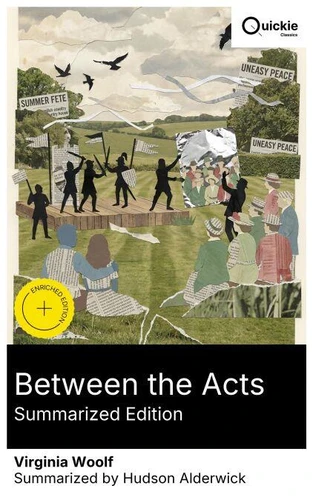
Over a single June day at Pointz Hall, Between the Acts presents a village pageant by Miss La Trobe, through which English history refracts while Isa and Giles Oliver's marriage strains at the margins. Woolf builds a modernist collage: choric voices, rough stage cues, gramophone snatches, and interruptions of weather and birdsong entangle spectators and actors until a mirror turns on the audience.
Written on the eve of war and published posthumously in 1941, the book fuses pastoral with experiment to test art, memory, and nationhood. Woolf, a central figure of Bloomsbury, drafted the novel in Sussex amid wartime anxiety and recurrent illness. Her diaries and essays show a sustained interest in amateur theatricals, village fêtes near Monk's House, and the fragile bonds of local life; these feed Miss La Trobe's uncompromising vision.
The stream-of-consciousness experiments of Mrs Dalloway and The Waves here assume a collective, theatrical shape. Recommended to readers of modernism, performance studies, and social history, Between the Acts offers a lucid meditation on how art convenes a fraying public. Lyrical yet unsparing, it rewards close study and will deepen conversations in seminars, book clubs, and solitary reading alike.
Quickie Classics summarizes timeless works with precision, preserving the author's voice and keeping the prose clear, fast, and readable-distilled, never diluted.
Enriched Edition extras: Introduction · Synopsis · Historical Context · Author Biography · Brief Analysis · 4 Reflection Q&As · Editorial Footnotes.
Over a single June day at Pointz Hall, Between the Acts presents a village pageant by Miss La Trobe, through which English history refracts while Isa and Giles Oliver's marriage strains at the margins. Woolf builds a modernist collage: choric voices, rough stage cues, gramophone snatches, and interruptions of weather and birdsong entangle spectators and actors until a mirror turns on the audience.
Written on the eve of war and published posthumously in 1941, the book fuses pastoral with experiment to test art, memory, and nationhood. Woolf, a central figure of Bloomsbury, drafted the novel in Sussex amid wartime anxiety and recurrent illness. Her diaries and essays show a sustained interest in amateur theatricals, village fêtes near Monk's House, and the fragile bonds of local life; these feed Miss La Trobe's uncompromising vision.
The stream-of-consciousness experiments of Mrs Dalloway and The Waves here assume a collective, theatrical shape. Recommended to readers of modernism, performance studies, and social history, Between the Acts offers a lucid meditation on how art convenes a fraying public. Lyrical yet unsparing, it rewards close study and will deepen conversations in seminars, book clubs, and solitary reading alike.
Quickie Classics summarizes timeless works with precision, preserving the author's voice and keeping the prose clear, fast, and readable-distilled, never diluted.
Enriched Edition extras: Introduction · Synopsis · Historical Context · Author Biography · Brief Analysis · 4 Reflection Q&As · Editorial Footnotes.

 , qui est-ce ?