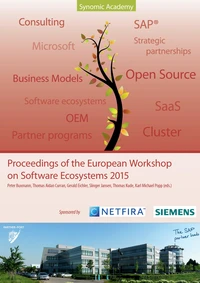
This book enables you to leverage the state-of-the-art of creating open source based business models and of managing open source in the development cycle of commercial software and during due diligence in mergers and acquisitions. In addition, it provides information about why investments in open source makes sense.
Practitioners, investors and consultants created this book to help professionals in the software business like investors, executives, business developers, product managers, architects, developers, quality managers, development operations managers as well as students to get acquainted and proficient in using open source products in a commercial context.
First, the focus is on business model impact of open source products and open source licenses.
Dr. Karl Michael Popp gives an overview of the different types of business models for open source companies. Dr. Josef Waltl shows how open source licenses and intellectual property strategies can create a unique business model based on a combination of open source and proprietary software.
Then, the focus is on detection and license compliance aspects of open source software in mergers and acquisitions.
The acquisition of a software vendor requires the review of intellectual property rights including open source license compliance as described by Dr. Karl Michael Popp.
The following new chapter, authored by Joseph Jacks from OSS Capital, provides fundamentals of the open source business by elaborating on value creation and value capture for commercial open source companies.
Then, two chapters cover the offerings of tool vendors for governance of open source software but also for development enablement.
First, Bill Weinberg and Greg Olsen show the broad offering of solutions of Black Duck Software, a provider for open source governance and enablement tools.
The next, new chapter, provided by Snyk, focuses on development aspects of using open source software as part of commercial products like assistance for developers in selection and in continuously updating open source components during the software development lifecycle.
This book enables you to leverage the state-of-the-art of creating open source based business models and of managing open source in the development cycle of commercial software and during due diligence in mergers and acquisitions. In addition, it provides information about why investments in open source makes sense.
Practitioners, investors and consultants created this book to help professionals in the software business like investors, executives, business developers, product managers, architects, developers, quality managers, development operations managers as well as students to get acquainted and proficient in using open source products in a commercial context.
First, the focus is on business model impact of open source products and open source licenses.
Dr. Karl Michael Popp gives an overview of the different types of business models for open source companies. Dr. Josef Waltl shows how open source licenses and intellectual property strategies can create a unique business model based on a combination of open source and proprietary software.
Then, the focus is on detection and license compliance aspects of open source software in mergers and acquisitions.
The acquisition of a software vendor requires the review of intellectual property rights including open source license compliance as described by Dr. Karl Michael Popp.
The following new chapter, authored by Joseph Jacks from OSS Capital, provides fundamentals of the open source business by elaborating on value creation and value capture for commercial open source companies.
Then, two chapters cover the offerings of tool vendors for governance of open source software but also for development enablement.
First, Bill Weinberg and Greg Olsen show the broad offering of solutions of Black Duck Software, a provider for open source governance and enablement tools.
The next, new chapter, provided by Snyk, focuses on development aspects of using open source software as part of commercial products like assistance for developers in selection and in continuously updating open source components during the software development lifecycle.