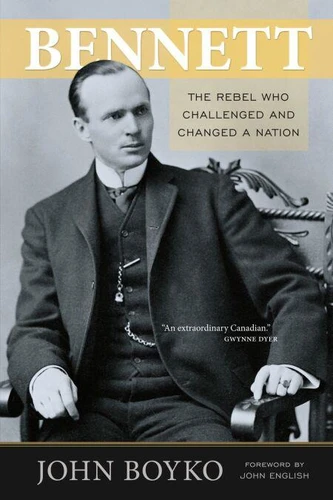
Bennett. The Rebel Who Challenged and Changed a Nation
Par :Formats :
Disponible dans votre compte client Decitre ou Furet du Nord dès validation de votre commande. Le format ePub est :
- Compatible avec une lecture sur My Vivlio (smartphone, tablette, ordinateur)
- Compatible avec une lecture sur liseuses Vivlio
- Pour les liseuses autres que Vivlio, vous devez utiliser le logiciel Adobe Digital Edition. Non compatible avec la lecture sur les liseuses Kindle, Remarkable et Sony
 , qui est-ce ?
Notre partenaire de plateforme de lecture numérique où vous retrouverez l'ensemble de vos ebooks gratuitement
Pour en savoir plus sur nos ebooks, consultez notre aide en ligne ici
C'est si simple ! Lisez votre ebook avec l'app Vivlio sur votre tablette, mobile ou ordinateur :

- Nombre de pages502
- FormatePub
- ISBN978-0-86492-744-6
- EAN9780864927446
- Date de parution30/03/2012
- Protection num.pas de protection
- Taille1 Mo
- Infos supplémentairesepub
- ÉditeurGoose Lane Editions
Résumé
In the late 1920s, Canada's economy was showing all the signs of a full-fledged depression. Life savings were evaporating, unemployment was up, and exports were dramatically down. Riding on the popularity of his promise to "blast" Canada's way into world markets - and thus stop the economy's downward spiral - Richard Bedford Bennett defeated William Lyon Mackenzie King at the polls on July 28, 1930, and assumed the leadership of the country.
Over the next five years, however, Bennett's name became synonymous with the worst of the Depression - from Bennett buggies, to Bennett tea, to Bennett-burghs. Eighty years later, he is widely viewed as a difficult man, an ineffectual leader, and a politician who "flip-flopped" on his conservative beliefs in exchange for popularity. John Boyko offers not only the first major biography of the man, but a fresh perspective on the old scholarship.
Boyko looks at the Prime Minister's sometimes controversial and often misunderstood policies through a longer lens, one that shows not a politician angling for votes, but rather a man following through on a life-long dedication to a greater role for government in society and the economy. It is easy to understand why Bennett has been so misunderstood. It is not often, after all, that a Conservative Prime Minister finds himself to the left of his Liberal opposition, but that it exactly where Bennett landed.
Bennett's New Deal - a series of proposals that included unemployment insurance; the establishment of a minimum wage and limits on work hours; an extension of federally backed farm credit; fair-trade and anti-monopoly legislation; and a revamped Wheat Board to oversee and control grain prices - was certainly a departure from the Conservative politics of the day. The same could be said for his creation of the Bank of Canada and the Canadian Radio Broadcasting Commission.
In Bennett: The Rebel Who Challenged and Changed a Nation, John Boyko explores the origins and hardening of those beliefs as he details Bennett's birth (into relative poverty) in Hopewell Cape, New Brunswick, his stunning success as a corporate lawyer and financial entrepreneur in Calgary, his years in politics, and his eventual retirement in England. As he ranges through the ups and downs of his subject's career, Boyko also invites his reader to compare the challenges faced by Bennett to those faced in Canada's more recent history.
Nearly every other Canadian prime minister finds his or her way into the analysis, with Bennett's beliefs and actions measured against theirs.
Over the next five years, however, Bennett's name became synonymous with the worst of the Depression - from Bennett buggies, to Bennett tea, to Bennett-burghs. Eighty years later, he is widely viewed as a difficult man, an ineffectual leader, and a politician who "flip-flopped" on his conservative beliefs in exchange for popularity. John Boyko offers not only the first major biography of the man, but a fresh perspective on the old scholarship.
Boyko looks at the Prime Minister's sometimes controversial and often misunderstood policies through a longer lens, one that shows not a politician angling for votes, but rather a man following through on a life-long dedication to a greater role for government in society and the economy. It is easy to understand why Bennett has been so misunderstood. It is not often, after all, that a Conservative Prime Minister finds himself to the left of his Liberal opposition, but that it exactly where Bennett landed.
Bennett's New Deal - a series of proposals that included unemployment insurance; the establishment of a minimum wage and limits on work hours; an extension of federally backed farm credit; fair-trade and anti-monopoly legislation; and a revamped Wheat Board to oversee and control grain prices - was certainly a departure from the Conservative politics of the day. The same could be said for his creation of the Bank of Canada and the Canadian Radio Broadcasting Commission.
In Bennett: The Rebel Who Challenged and Changed a Nation, John Boyko explores the origins and hardening of those beliefs as he details Bennett's birth (into relative poverty) in Hopewell Cape, New Brunswick, his stunning success as a corporate lawyer and financial entrepreneur in Calgary, his years in politics, and his eventual retirement in England. As he ranges through the ups and downs of his subject's career, Boyko also invites his reader to compare the challenges faced by Bennett to those faced in Canada's more recent history.
Nearly every other Canadian prime minister finds his or her way into the analysis, with Bennett's beliefs and actions measured against theirs.
A propos de John Boyko

15,21 €

29,43 €