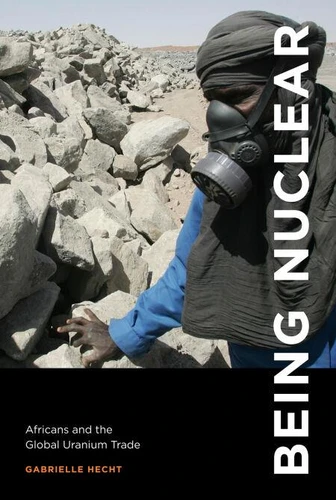
Being Nuclear. Africans and the Global Uranium Trade
Par :Formats :
Disponible dans votre compte client Decitre ou Furet du Nord dès validation de votre commande. Le format ePub protégé est :
- Compatible avec une lecture sur My Vivlio (smartphone, tablette, ordinateur)
- Compatible avec une lecture sur liseuses Vivlio
- Pour les liseuses autres que Vivlio, vous devez utiliser le logiciel Adobe Digital Edition. Non compatible avec la lecture sur les liseuses Kindle, Remarkable et Sony
- Non compatible avec un achat hors France métropolitaine
 , qui est-ce ?
Notre partenaire de plateforme de lecture numérique où vous retrouverez l'ensemble de vos ebooks gratuitement
Pour en savoir plus sur nos ebooks, consultez notre aide en ligne ici
C'est si simple ! Lisez votre ebook avec l'app Vivlio sur votre tablette, mobile ou ordinateur :

- Nombre de pages480
- FormatePub
- ISBN978-0-262-30067-4
- EAN9780262300674
- Date de parution02/03/2012
- Protection num.Adobe DRM
- Taille18 Mo
- Infos supplémentairesepub
- ÉditeurThe MIT Press
Résumé
The hidden history of African uranium and what it means-for a state, an object, an industry, a workplace-to be "nuclear."Uranium from Africa has long been a major source of fuel for nuclear power and atomic weapons, including the bomb dropped on Hiroshima. In 2003, after the infamous "yellow cake from Niger, " Africa suddenly became notorious as a source of uranium, a component of nuclear weapons.
But did that admit Niger, or any of Africa's other uranium-producing countries, to the select society of nuclear states? Does uranium itself count as a nuclear thing? In this book, Gabrielle Hecht lucidly probes the question of what it means for something-a state, an object, an industry, a workplace-to be "nuclear." Hecht shows that questions about being nuclear-a state that she calls "nuclearity"-lie at the heart of today's global nuclear order and the relationships between "developing nations" (often former colonies) and "nuclear powers" (often former colonizers).
Hecht enters African nuclear worlds, focusing on miners and the occupational hazard of radiation exposure. Could a mine be a nuclear workplace if (as in some South African mines) its radiation levels went undetected and unmeasured? With this book, Hecht is the first to put Africa in the nuclear world, and the nuclear world in Africa. By doing so, she remakes our understanding of the nuclear age.
But did that admit Niger, or any of Africa's other uranium-producing countries, to the select society of nuclear states? Does uranium itself count as a nuclear thing? In this book, Gabrielle Hecht lucidly probes the question of what it means for something-a state, an object, an industry, a workplace-to be "nuclear." Hecht shows that questions about being nuclear-a state that she calls "nuclearity"-lie at the heart of today's global nuclear order and the relationships between "developing nations" (often former colonies) and "nuclear powers" (often former colonizers).
Hecht enters African nuclear worlds, focusing on miners and the occupational hazard of radiation exposure. Could a mine be a nuclear workplace if (as in some South African mines) its radiation levels went undetected and unmeasured? With this book, Hecht is the first to put Africa in the nuclear world, and the nuclear world in Africa. By doing so, she remakes our understanding of the nuclear age.