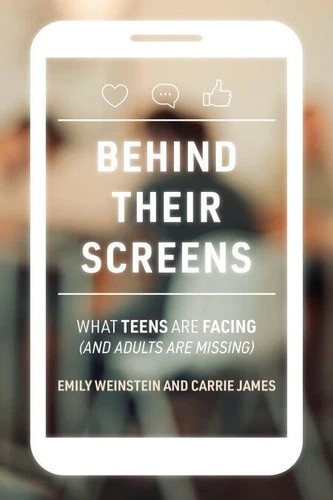
Behind Their Screens. What Teens Are Facing (and Adults Are Missing)
Par : ,Formats :
Disponible dans votre compte client Decitre ou Furet du Nord dès validation de votre commande. Le format ePub protégé est :
- Compatible avec une lecture sur My Vivlio (smartphone, tablette, ordinateur)
- Compatible avec une lecture sur liseuses Vivlio
- Pour les liseuses autres que Vivlio, vous devez utiliser le logiciel Adobe Digital Edition. Non compatible avec la lecture sur les liseuses Kindle, Remarkable et Sony
- Non compatible avec un achat hors France métropolitaine
 , qui est-ce ?
Notre partenaire de plateforme de lecture numérique où vous retrouverez l'ensemble de vos ebooks gratuitement
Pour en savoir plus sur nos ebooks, consultez notre aide en ligne ici
C'est si simple ! Lisez votre ebook avec l'app Vivlio sur votre tablette, mobile ou ordinateur :

- Nombre de pages240
- FormatePub
- ISBN978-0-262-37142-1
- EAN9780262371421
- Date de parution16/08/2022
- Protection num.Adobe DRM
- Taille498 Ko
- Infos supplémentairesepub
- ÉditeurThe MIT Press
Résumé
TEENS AND THEIR SCREENS: Harvard researchers reveal how younger generations navigate a networked world-and how adults can support them. "A new and important voice to the conversation around teenagers and the ways we interact with our screens." -San Francisco Chronicle What are teens actually doing on their smartphones? Contrary to many adults' assumptions, they are not simply "addicted" to their screens, oblivious to the afterlife of what they post, or missing out on personal connection.
They are just trying to navigate a networked world. In Behind Their Screens, Emily Weinstein and Carrie James, Harvard researchers who are experts on teens and technology, explore the complexities that teens face in their digital lives, and suggest that many adult efforts to help-"Get off your phone!" "Just don't sext!"-fall short. Weinstein and James warn against a single-minded focus by adults on "screen time." Teens worry about dependence on their devices, but disconnecting means being out of the loop socially, with absence perceived as rudeness or even a failure to be there for a struggling friend.
Drawing on a multiyear project that surveyed more than 3, 500 teens, the authors explain that young people need empathy, not exasperated eye-rolling. Adults should understand the complicated nature of teens' online life rather than issue commands, and they should normalize-let teens know that their challenges are shared by others-without minimizing or dismissing. Along the way, Weinstein and James describe different kinds of sexting and explain such phenomena as watermarking nudes, comparison quicksand, digital pacifiers, and collecting receipts.
Behind Their Screens offers essential reading for any adult who cares about supporting teens in an online world.
They are just trying to navigate a networked world. In Behind Their Screens, Emily Weinstein and Carrie James, Harvard researchers who are experts on teens and technology, explore the complexities that teens face in their digital lives, and suggest that many adult efforts to help-"Get off your phone!" "Just don't sext!"-fall short. Weinstein and James warn against a single-minded focus by adults on "screen time." Teens worry about dependence on their devices, but disconnecting means being out of the loop socially, with absence perceived as rudeness or even a failure to be there for a struggling friend.
Drawing on a multiyear project that surveyed more than 3, 500 teens, the authors explain that young people need empathy, not exasperated eye-rolling. Adults should understand the complicated nature of teens' online life rather than issue commands, and they should normalize-let teens know that their challenges are shared by others-without minimizing or dismissing. Along the way, Weinstein and James describe different kinds of sexting and explain such phenomena as watermarking nudes, comparison quicksand, digital pacifiers, and collecting receipts.
Behind Their Screens offers essential reading for any adult who cares about supporting teens in an online world.