Can the human mind truly change?For thousands of years, philosophers, mystics, priests, and healers have insisted that human beings are capable of profound transformation. Today, neuroscience demonstrates that the brain is not fixed but continually reshapes itself through experience, attention, memory, and disciplined practice. At the same time, the revolutionary discoveries of quantum physics have challenged many of our deepest assumptions about matter, observation, and reality itself.
Yet somewhere between scientific discovery and spiritual longing lies a landscape filled with misunderstanding, exaggerated claims, and unanswered questions.'Becoming Otherwise' is an ambitious exploration of that landscape. Drawing upon contemporary neuroscience, cognitive psychology, philosophy of mind, quantum theory, comparative religion, and the history of Western and Eastern spirituality, this work examines one of humanity's oldest questions: How does a person truly become someone new?Rather than offering simplistic promises of manifestation or dismissing spirituality through reductionist materialism, this book carefully distinguishes between established scientific evidence, philosophical speculation, and religious insight.
It investigates the remarkable capacity of neuroplasticity to reshape identity through repeated experience while exploring the profound philosophical implications raised by thinkers such as Max Planck and Erwin Schrödinger regarding the nature of consciousness. Along the way, readers will encounter the work of Donald Hebb, Michael Merzenich, William James, Carl Jung, Max Planck, Erwin Schrödinger, Fred Alan Wolf, Deepak Chopra, Joe Dispenza, and many others whose ideas have shaped modern discussions of mind, meaning, and transformation.
Their contributions are presented critically, respectfully, and historically, separating empirical findings from metaphysical interpretation while showing how each has influenced contemporary thinking about personal growth. The book explores questions that have fascinated both scientists and mystics for generations: What does neuroscience actually demonstrate about changing habits, emotions, and identity? How do attention, meditation, ritual, and repeated behavior reshape the nervous system? What did the founders of quantum mechanics truly believe about consciousness, and how have their ideas been interpreted-or misinterpreted-by later writers? Can ritual function as a technology of psychological transformation regardless of one's religious beliefs? Why do symbols, myths, ceremonies, and devotional practices continue to exert such profound influence over human life? How can ancient spiritual disciplines and modern neuroscience illuminate one another without confusing science with metaphysics?
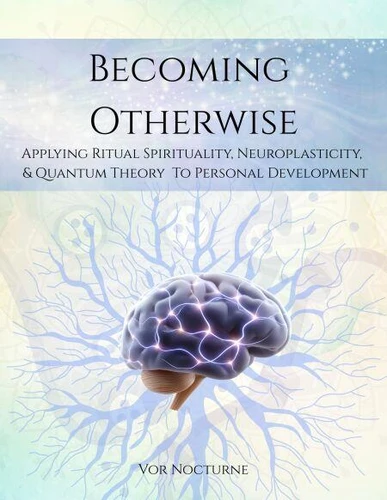
Can the human mind truly change?For thousands of years, philosophers, mystics, priests, and healers have insisted that human beings are capable of profound transformation. Today, neuroscience demonstrates that the brain is not fixed but continually reshapes itself through experience, attention, memory, and disciplined practice. At the same time, the revolutionary discoveries of quantum physics have challenged many of our deepest assumptions about matter, observation, and reality itself.
Yet somewhere between scientific discovery and spiritual longing lies a landscape filled with misunderstanding, exaggerated claims, and unanswered questions.'Becoming Otherwise' is an ambitious exploration of that landscape. Drawing upon contemporary neuroscience, cognitive psychology, philosophy of mind, quantum theory, comparative religion, and the history of Western and Eastern spirituality, this work examines one of humanity's oldest questions: How does a person truly become someone new?Rather than offering simplistic promises of manifestation or dismissing spirituality through reductionist materialism, this book carefully distinguishes between established scientific evidence, philosophical speculation, and religious insight.
It investigates the remarkable capacity of neuroplasticity to reshape identity through repeated experience while exploring the profound philosophical implications raised by thinkers such as Max Planck and Erwin Schrödinger regarding the nature of consciousness. Along the way, readers will encounter the work of Donald Hebb, Michael Merzenich, William James, Carl Jung, Max Planck, Erwin Schrödinger, Fred Alan Wolf, Deepak Chopra, Joe Dispenza, and many others whose ideas have shaped modern discussions of mind, meaning, and transformation.
Their contributions are presented critically, respectfully, and historically, separating empirical findings from metaphysical interpretation while showing how each has influenced contemporary thinking about personal growth. The book explores questions that have fascinated both scientists and mystics for generations: What does neuroscience actually demonstrate about changing habits, emotions, and identity? How do attention, meditation, ritual, and repeated behavior reshape the nervous system? What did the founders of quantum mechanics truly believe about consciousness, and how have their ideas been interpreted-or misinterpreted-by later writers? Can ritual function as a technology of psychological transformation regardless of one's religious beliefs? Why do symbols, myths, ceremonies, and devotional practices continue to exert such profound influence over human life? How can ancient spiritual disciplines and modern neuroscience illuminate one another without confusing science with metaphysics?


 , qui est-ce ?