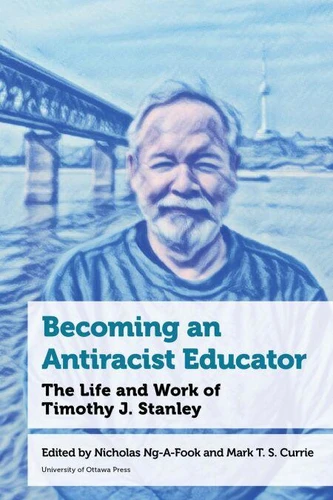
Becoming an Antiracist Educator. The Life and Work of Timothy J. Stanley
Par : , , , ,Formats :
Disponible dans votre compte client Decitre ou Furet du Nord dès validation de votre commande. Le format ePub est :
- Compatible avec une lecture sur My Vivlio (smartphone, tablette, ordinateur)
- Compatible avec une lecture sur liseuses Vivlio
- Pour les liseuses autres que Vivlio, vous devez utiliser le logiciel Adobe Digital Edition. Non compatible avec la lecture sur les liseuses Kindle, Remarkable et Sony
 , qui est-ce ?
Notre partenaire de plateforme de lecture numérique où vous retrouverez l'ensemble de vos ebooks gratuitement
Pour en savoir plus sur nos ebooks, consultez notre aide en ligne ici
C'est si simple ! Lisez votre ebook avec l'app Vivlio sur votre tablette, mobile ou ordinateur :

- Nombre de pages168
- FormatePub
- ISBN978-0-7766-4616-9
- EAN9780776646169
- Date de parution10/03/2026
- Protection num.pas de protection
- Taille2 Mo
- Infos supplémentairesepub
- ÉditeurUniversity of Ottawa Press
Résumé
Becoming an Antiracist Educator honours the enduring influence of Timothy J. Stanley, a visionary historian whose work has reshaped how racism, racialization, and historical consciousness are understood in Canada. This timely collection gathers scholars, teachers, and community advocates who reflect on how Stanley's scholarship and mentorship have challenged and guided their own commitments to antiracist education.
Spanning generations and disciplinary backgrounds, the contributors offer deeply personal and politically grounded reflections that connect Stanley's insights to the pressing realities of our time. They engage questions raised by the toppling of colonial statues, the resurgence of anti-Asian racism, and the uncovering of unmarked graves at residential school sites. Together, they show that antiracist teaching is not only about critiquing systems, but about reimagining how we understand the past, how we tell our histories, and how we live with one another in the present.
Concluding with a moving epilogue by Stanley, this collection speaks to educators, researchers, and community members seeking to confront racism in schools, museums, universities, and public life. It offers both a testament to his legacy and an invitation to carry that work forward with courage and care. Becoming an Antiracist Educator is an essential resource for educators, scholars, and community members committed to interrupting racism in schools, museums, universities, and beyond.
It offers not only an archive of Stanley's impact but a roadmap for those seeking to carry his work forward in practical and transformative ways. Also, listen to the FooknConversation podcast (episode 9): Dr. Stanley shares his perspectives as a historian about the invisibility of everyday racisms in Canada. He discusses some of the following concepts: the rise of anti-Chinese racisms, the tragic death of Colten Boushie, the grammar of settler colonial racializations, racisms, and organized exclusions, the genealogy of Canadian settler property rights, removing monuments, the genealogical privileging certain inclusions and exclusions, living in Montreal as a mixed race youth, banning public expressions of faith in Quebec, the removal of national statues, living in China, and so much more.
Link: https://www.fooknconversation.com/podcast/episode-09-timothy-stanley/
Spanning generations and disciplinary backgrounds, the contributors offer deeply personal and politically grounded reflections that connect Stanley's insights to the pressing realities of our time. They engage questions raised by the toppling of colonial statues, the resurgence of anti-Asian racism, and the uncovering of unmarked graves at residential school sites. Together, they show that antiracist teaching is not only about critiquing systems, but about reimagining how we understand the past, how we tell our histories, and how we live with one another in the present.
Concluding with a moving epilogue by Stanley, this collection speaks to educators, researchers, and community members seeking to confront racism in schools, museums, universities, and public life. It offers both a testament to his legacy and an invitation to carry that work forward with courage and care. Becoming an Antiracist Educator is an essential resource for educators, scholars, and community members committed to interrupting racism in schools, museums, universities, and beyond.
It offers not only an archive of Stanley's impact but a roadmap for those seeking to carry his work forward in practical and transformative ways. Also, listen to the FooknConversation podcast (episode 9): Dr. Stanley shares his perspectives as a historian about the invisibility of everyday racisms in Canada. He discusses some of the following concepts: the rise of anti-Chinese racisms, the tragic death of Colten Boushie, the grammar of settler colonial racializations, racisms, and organized exclusions, the genealogy of Canadian settler property rights, removing monuments, the genealogical privileging certain inclusions and exclusions, living in Montreal as a mixed race youth, banning public expressions of faith in Quebec, the removal of national statues, living in China, and so much more.
Link: https://www.fooknconversation.com/podcast/episode-09-timothy-stanley/