SOLDES
Jusqu'à -70% sur une sélection d'articles*

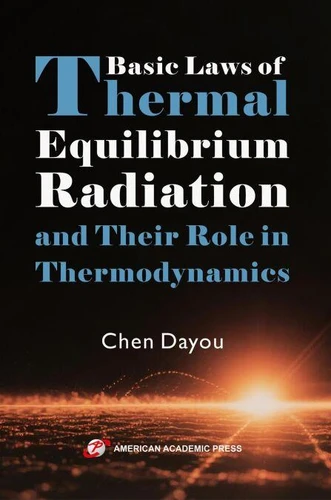
Basic Laws of Thermal Equilibrium Radiation and Their Role in Thermodynamics
Par :Formats :
Disponible dans votre compte client Decitre ou Furet du Nord dès validation de votre commande. Le format ePub est :
- Compatible avec une lecture sur My Vivlio (smartphone, tablette, ordinateur)
- Compatible avec une lecture sur liseuses Vivlio
- Pour les liseuses autres que Vivlio, vous devez utiliser le logiciel Adobe Digital Edition. Non compatible avec la lecture sur les liseuses Kindle, Remarkable et Sony
 , qui est-ce ?
Notre partenaire de plateforme de lecture numérique où vous retrouverez l'ensemble de vos ebooks gratuitement
Pour en savoir plus sur nos ebooks, consultez notre aide en ligne ici
C'est si simple ! Lisez votre ebook avec l'app Vivlio sur votre tablette, mobile ou ordinateur :

- FormatePub
- ISBN8233627095
- EAN9798233627095
- Date de parution19/12/2025
- Protection num.pas de protection
- Infos supplémentairesepub
- ÉditeurLinda Balsamo
Résumé
Based on an in-depth analysis of Planck's black-body radiation law, this book reveals, for the first time, the fundamental laws of thermal equilibrium radiation. The energy distribution of a material oscillator in a radiation field follows Boltzmann's law of energy distribution; the probability that the oscillator excites radiation is proportional to the energy level state of the oscillator, and the likelihood of the oscillator absorbing radiation is proportional to the probability of the oscillator's energy distribution.
The former describes the oscillator's energy distribution statically, and the latter dynamically reveals the law of energy exchange between the oscillator and the radiation field. They both belong to two aspects of the fundamental laws of thermal radiation. The author proposes the concept of space quantization, analyzes and demonstrates the universe's elastic mechanical properties, identifies discontinuities in the motion of microscopic particles, and introduces the concepts of volume energy and transient gravitational waves.
On this basis, he derives the de Broglie relationship, analyzes the energy states of microscopic resonators and the mechanism of excited radiation, and proposes and explains the physical meaning of the Planck constant. In general relativity, it is suggested that the gravitational field is a manifestation of an object's volume energy, and the tidal force tensor is shown to be the energy component of the energy-momentum tensor.
From a new perspective, the Schwarzschild metric for a spherically symmetric gravitational field is derived using the variational method. The quantum space background of the mass-energy relationship is analyzed, and the dynamic issues of the universe's expansion are discussed.
The former describes the oscillator's energy distribution statically, and the latter dynamically reveals the law of energy exchange between the oscillator and the radiation field. They both belong to two aspects of the fundamental laws of thermal radiation. The author proposes the concept of space quantization, analyzes and demonstrates the universe's elastic mechanical properties, identifies discontinuities in the motion of microscopic particles, and introduces the concepts of volume energy and transient gravitational waves.
On this basis, he derives the de Broglie relationship, analyzes the energy states of microscopic resonators and the mechanism of excited radiation, and proposes and explains the physical meaning of the Planck constant. In general relativity, it is suggested that the gravitational field is a manifestation of an object's volume energy, and the tidal force tensor is shown to be the energy component of the energy-momentum tensor.
From a new perspective, the Schwarzschild metric for a spherically symmetric gravitational field is derived using the variational method. The quantum space background of the mass-energy relationship is analyzed, and the dynamic issues of the universe's expansion are discussed.