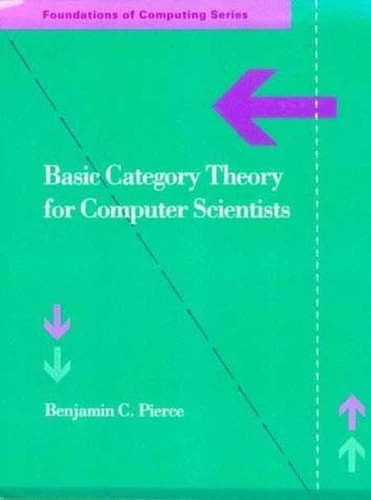
Basic Category Theory for Computer Scientists provides a straightforward presentation of the basic constructions and terminology of category theory, including limits, functors, natural transformations, adjoints, and cartesian closed categories. Category theory is a branch of pure mathematics that is becoming an increasingly important tool in theoretical computer science, especially in programming language semantics, domain theory, and concurrency, where it is already a standard language of discourse.
Assuming a minimum of mathematical preparation, Basic Category Theory for Computer Scientists provides a straightforward presentation of the basic constructions and terminology of category theory, including limits, functors, natural transformations, adjoints, and cartesian closed categories. Four case studies illustrate applications of category theory to programming language design, semantics, and the solution of recursive domain equations.
A brief literature survey offers suggestions for further study in more advanced texts. ContentsTutorial . Applications . Further Reading
Basic Category Theory for Computer Scientists provides a straightforward presentation of the basic constructions and terminology of category theory, including limits, functors, natural transformations, adjoints, and cartesian closed categories. Category theory is a branch of pure mathematics that is becoming an increasingly important tool in theoretical computer science, especially in programming language semantics, domain theory, and concurrency, where it is already a standard language of discourse.
Assuming a minimum of mathematical preparation, Basic Category Theory for Computer Scientists provides a straightforward presentation of the basic constructions and terminology of category theory, including limits, functors, natural transformations, adjoints, and cartesian closed categories. Four case studies illustrate applications of category theory to programming language design, semantics, and the solution of recursive domain equations.
A brief literature survey offers suggestions for further study in more advanced texts. ContentsTutorial . Applications . Further Reading

 , qui est-ce ?
