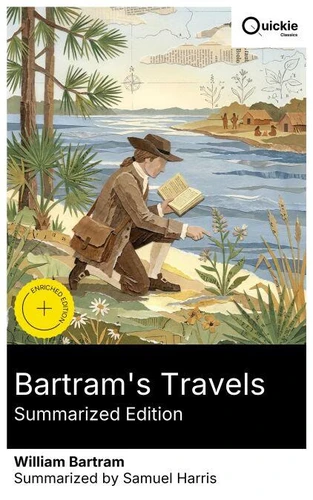
Bartram's Travels (Summarized Edition). Enriched edition. An Enlightenment-era naturalist travelogue of the Carolinas, Georgia, and Florida: taxonomy, field observation, and Creek & Cherokee encounters
Par : ,Formats :
Disponible dans votre compte client Decitre ou Furet du Nord dès validation de votre commande. Le format ePub est :
- Compatible avec une lecture sur My Vivlio (smartphone, tablette, ordinateur)
- Compatible avec une lecture sur liseuses Vivlio
- Pour les liseuses autres que Vivlio, vous devez utiliser le logiciel Adobe Digital Edition. Non compatible avec la lecture sur les liseuses Kindle, Remarkable et Sony
 , qui est-ce ?
Notre partenaire de plateforme de lecture numérique où vous retrouverez l'ensemble de vos ebooks gratuitement
Pour en savoir plus sur nos ebooks, consultez notre aide en ligne ici
C'est si simple ! Lisez votre ebook avec l'app Vivlio sur votre tablette, mobile ou ordinateur :

- Nombre de pages129
- FormatePub
- ISBN859-65--4787763-9
- EAN8596547877639
- Date de parution10/01/2026
- Protection num.Digital Watermarking
- Taille892 Ko
- Infos supplémentairesepub
- ÉditeurQUICKIE CLASSICS
Résumé
First published in 1791, Bartram's Travels surveys the Carolinas, Georgia, and East and West Florida, fusing precise natural history with soaring descriptive prose. Along the St. Johns River, the Alachua Savanna, and the Okefenokee, Bartram records flora and fauna in Linnaean terms, while rendering light, weather, and motion with proto-Romantic intensity. The narrative moves from measurements and seasonal notes to attentive accounts of Creek, Cherokee, and Seminole life, establishing a formative American blend of science, travel narrative, and early environmental writing that later resonated with British Romanticism.
William Bartram, a Philadelphia Quaker and son of renowned botanist John Bartram, combined training in illustration and field botany with a pacifist ethic of observation. Backed by the London physician John Fothergill, he traveled the Southeast from 1773 to 1777 collecting specimens, seeds, and drawings. Encounters with Indigenous guides, plantations, and fragile borderlands on the eve of revolution shaped his balanced voice-empirical yet reverent, skeptical of conquest, and keen to register local knowledge.
Scholars and general readers will value this classic for its integrative method and ethical poise. Read it for taxonomy enlivened by vision, for Indigenous encounters handled with tact, and for a still-urgent meditation on place. Quickie Classics summarizes timeless works with precision, preserving the author's voice and keeping the prose clear, fast, and readable-distilled, never diluted. Enriched Edition extras: Introduction · Synopsis · Historical Context · Brief Analysis · 4 Reflection Q&As · Editorial Footnotes.
William Bartram, a Philadelphia Quaker and son of renowned botanist John Bartram, combined training in illustration and field botany with a pacifist ethic of observation. Backed by the London physician John Fothergill, he traveled the Southeast from 1773 to 1777 collecting specimens, seeds, and drawings. Encounters with Indigenous guides, plantations, and fragile borderlands on the eve of revolution shaped his balanced voice-empirical yet reverent, skeptical of conquest, and keen to register local knowledge.
Scholars and general readers will value this classic for its integrative method and ethical poise. Read it for taxonomy enlivened by vision, for Indigenous encounters handled with tact, and for a still-urgent meditation on place. Quickie Classics summarizes timeless works with precision, preserving the author's voice and keeping the prose clear, fast, and readable-distilled, never diluted. Enriched Edition extras: Introduction · Synopsis · Historical Context · Brief Analysis · 4 Reflection Q&As · Editorial Footnotes.