SOLDES
Jusqu'à -70% sur une sélection d'articles*

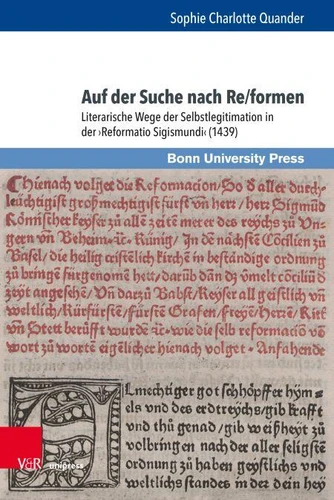
Auf der Suche nach Re/formen. Literarische Wege der Selbstlegitimation in der ›Reformatio Sigismundi‹ (1439)
Par :Formats :
Disponible dans votre compte client Decitre ou Furet du Nord dès validation de votre commande. Le format PDF est :
- Compatible avec une lecture sur My Vivlio (smartphone, tablette, ordinateur)
- Compatible avec une lecture sur liseuses Vivlio
- Pour les liseuses autres que Vivlio, vous devez utiliser le logiciel Adobe Digital Edition. Non compatible avec la lecture sur les liseuses Kindle, Remarkable et Sony
 , qui est-ce ?
Notre partenaire de plateforme de lecture numérique où vous retrouverez l'ensemble de vos ebooks gratuitement
Pour en savoir plus sur nos ebooks, consultez notre aide en ligne ici
C'est si simple ! Lisez votre ebook avec l'app Vivlio sur votre tablette, mobile ou ordinateur :

- Nombre de pages336
- FormatPDF
- ISBN978-3-8470-1599-4
- EAN9783847015994
- Date de parution04/09/2023
- Protection num.pas de protection
- Taille10 Mo
- Infos supplémentairespdf
- ÉditeurV&R Unipress
Résumé
Was braucht es, damit eine Reform gelingt? Die >Reformatio Sigismundi< (1439) scheint diese Frage nicht zuletzt formal zu stellen, wenn ihr anonym gebliebener Verfasser seine Ideen auf Deutsch diskutiert und mit volkssprachigen Elementen aus Predigt, Prophetie und politischer Publizistik anreichert. Mitten in der auf dem Basler Konzil geführten lateinischen Debatte um eine Reform von Kirche und Reich entsteht so der erste umfassende Reformtext in deutscher Sprache.
Unbeantwortet blieb bisher, weshalb der Anonymus die Volkssprache wählt und wie sich der Sprachwechsel auf Argumentation und Intention des Textes auswirkt. Die Studie arbeitet die >Reformatio Sigismundi< erstmals literaturwissenschaftlich auf und erprobt dabei unterschiedliche philologische Methoden für die Arbeit mit historischen Quellen. What does it take for a reform to succeed? The 'Reformatio Sigismundi' (1439) seems to pose this question regarding its own literary form: its anonymous author presents his ideas in German while enriching them with vernacular elements from sermons, prophecies and political publicity.
Thus, in the midst of the Latin debate on a reform of church and empire at the Council of Basel, emerges the very first comprehensive reform text in German. So far, it remains unanswered why the anonymous author chooses the vernacular and how the change of language affects the argumentation and intention of the text. This study is the first to examine the 'Reformatio Sigismundi' from a literary perspective testing different philological methods in working with historical sources.
Unbeantwortet blieb bisher, weshalb der Anonymus die Volkssprache wählt und wie sich der Sprachwechsel auf Argumentation und Intention des Textes auswirkt. Die Studie arbeitet die >Reformatio Sigismundi< erstmals literaturwissenschaftlich auf und erprobt dabei unterschiedliche philologische Methoden für die Arbeit mit historischen Quellen. What does it take for a reform to succeed? The 'Reformatio Sigismundi' (1439) seems to pose this question regarding its own literary form: its anonymous author presents his ideas in German while enriching them with vernacular elements from sermons, prophecies and political publicity.
Thus, in the midst of the Latin debate on a reform of church and empire at the Council of Basel, emerges the very first comprehensive reform text in German. So far, it remains unanswered why the anonymous author chooses the vernacular and how the change of language affects the argumentation and intention of the text. This study is the first to examine the 'Reformatio Sigismundi' from a literary perspective testing different philological methods in working with historical sources.