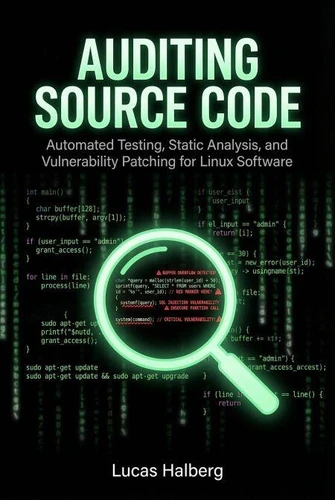
Auditing Source Code: Automated Testing, Static Analysis, and Vulnerability Patching for Linux Software. Secure Coding Standards
Par :Formats :
Disponible dans votre compte client Decitre ou Furet du Nord dès validation de votre commande. Le format ePub protégé est :
- Compatible avec une lecture sur My Vivlio (smartphone, tablette, ordinateur)
- Compatible avec une lecture sur liseuses Vivlio
- Pour les liseuses autres que Vivlio, vous devez utiliser le logiciel Adobe Digital Edition. Non compatible avec la lecture sur les liseuses Kindle, Remarkable et Sony
- Non compatible avec un achat hors France métropolitaine
 , qui est-ce ?
Notre partenaire de plateforme de lecture numérique où vous retrouverez l'ensemble de vos ebooks gratuitement
Pour en savoir plus sur nos ebooks, consultez notre aide en ligne ici
C'est si simple ! Lisez votre ebook avec l'app Vivlio sur votre tablette, mobile ou ordinateur :

- FormatePub
- ISBN8235133839
- EAN9798235133839
- Date de parution13/03/2026
- Protection num.Adobe DRM
- Infos supplémentairesepub
- ÉditeurIoakim Ioakim
Résumé
Master the art of ethical vulnerability discovery and remediation in Linux environments. Deploying unaudited software into a production Linux environment is a significant liability. Hidden vulnerabilities in C, C++, or system-level code can remain dormant for years, only to be exploited at a high cost to organizations and users. Auditing Source Code: Automated Testing, Static Analysis, and Vulnerability Patching for Linux Software is your definitive educational guide to securing the foundational layer of modern computing.
This comprehensive resource bridges the gap between traditional software development and specialized, defensive vulnerability research. Written for software developers, security engineers, and DevOps practitioners, this book provides a rigorous, hands-on methodology for analyzing complex codebases to protect systems from harm. Inside, you will discover how to: Construct a reproducible auditing laboratory using Docker and modern Linux toolchains.
Perform manual code reviews to identify memory corruption, logic flaws, and privilege escalation vectors. Harness compiler-based static analysis using GCC and Clang for deep interprocedural checks. Deploy dedicated analyzers like Cppcheck, Semgrep, and CodeQL to automate vulnerability detection at scale. Execute coverage-guided fuzzing campaigns with AFL++ and LibFuzzer to find unpredictable edge cases safely.
Implement runtime instrumentation to catch hidden bugs during execution. Write resilient, regression-tested patches that eliminate root causes without breaking existing functionality. Integrate continuous auditing directly into your CI/CD pipelines and supply chain. Security cannot be a one-time event. It must be a continuous, ethical engineering discipline. Whether you are transitioning from external penetration testing to internal code review, or building automated security gates for your enterprise, this book equips you with the professional tools required to fortify the integrity of your Linux software.
Stop reacting to vulnerabilities after deployment. Shift left, automate your security testing, and harden your infrastructure at the source.
This comprehensive resource bridges the gap between traditional software development and specialized, defensive vulnerability research. Written for software developers, security engineers, and DevOps practitioners, this book provides a rigorous, hands-on methodology for analyzing complex codebases to protect systems from harm. Inside, you will discover how to: Construct a reproducible auditing laboratory using Docker and modern Linux toolchains.
Perform manual code reviews to identify memory corruption, logic flaws, and privilege escalation vectors. Harness compiler-based static analysis using GCC and Clang for deep interprocedural checks. Deploy dedicated analyzers like Cppcheck, Semgrep, and CodeQL to automate vulnerability detection at scale. Execute coverage-guided fuzzing campaigns with AFL++ and LibFuzzer to find unpredictable edge cases safely.
Implement runtime instrumentation to catch hidden bugs during execution. Write resilient, regression-tested patches that eliminate root causes without breaking existing functionality. Integrate continuous auditing directly into your CI/CD pipelines and supply chain. Security cannot be a one-time event. It must be a continuous, ethical engineering discipline. Whether you are transitioning from external penetration testing to internal code review, or building automated security gates for your enterprise, this book equips you with the professional tools required to fortify the integrity of your Linux software.
Stop reacting to vulnerabilities after deployment. Shift left, automate your security testing, and harden your infrastructure at the source.