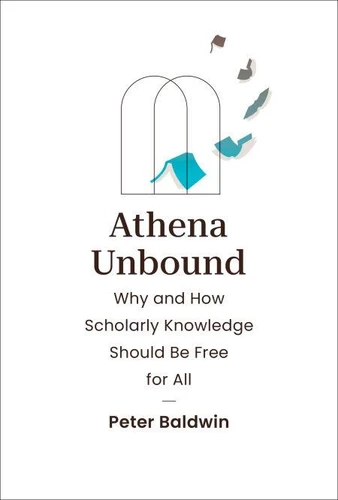
Athena Unbound. Why and How Scholarly Knowledge Should Be Free for All
Par :Formats :
Disponible dans votre compte client Decitre ou Furet du Nord dès validation de votre commande. Le format ePub protégé est :
- Compatible avec une lecture sur My Vivlio (smartphone, tablette, ordinateur)
- Compatible avec une lecture sur liseuses Vivlio
- Pour les liseuses autres que Vivlio, vous devez utiliser le logiciel Adobe Digital Edition. Non compatible avec la lecture sur les liseuses Kindle, Remarkable et Sony
- Non compatible avec un achat hors France métropolitaine
 , qui est-ce ?
Notre partenaire de plateforme de lecture numérique où vous retrouverez l'ensemble de vos ebooks gratuitement
Pour en savoir plus sur nos ebooks, consultez notre aide en ligne ici
C'est si simple ! Lisez votre ebook avec l'app Vivlio sur votre tablette, mobile ou ordinateur :

- Nombre de pages360
- FormatePub
- ISBN978-0-262-37395-1
- EAN9780262373951
- Date de parution28/03/2023
- Protection num.Adobe DRM
- Taille479 Ko
- Infos supplémentairesepub
- ÉditeurThe MIT Press
Résumé
A clear-eyed examination of the open access movement: past history, current conflicts, and future possibilities. Open access (OA) could one day put the sum of human knowledge at our fingertips. But the goal of allowing everyone to read everything faces fierce resistance. In Athena Unbound, Peter Baldwin offers an up-to-date look at the ideals and history behind OA, and unpacks the controversies that arise when the dream of limitless information slams into entrenched interests in favor of the status quo.
In addition to providing a clear analysis of the debates, Baldwin focuses on thorny issues such as copyright and ways to pay for "free" knowledge. He also provides a roadmap that would make OA economically viable and, as a result, advance one of humanity's age-old ambitions. Baldwin addresses the arguments in terms of disseminating scientific research, the history of intellectual property and copyright, and the development of the university and research establishment.
As he notes, the hard sciences have already created a funding model that increasingly provides open access, but at the cost of crowding out the humanities. Baldwin proposes a new system that would shift costs from consumers to producers and free scholarly knowledge from the paywalls and institutional barriers that keep it from much of the world. Rich in detail and free of jargon, Athena Unbound is an essential primer on the state of the global open access movement.
In addition to providing a clear analysis of the debates, Baldwin focuses on thorny issues such as copyright and ways to pay for "free" knowledge. He also provides a roadmap that would make OA economically viable and, as a result, advance one of humanity's age-old ambitions. Baldwin addresses the arguments in terms of disseminating scientific research, the history of intellectual property and copyright, and the development of the university and research establishment.
As he notes, the hard sciences have already created a funding model that increasingly provides open access, but at the cost of crowding out the humanities. Baldwin proposes a new system that would shift costs from consumers to producers and free scholarly knowledge from the paywalls and institutional barriers that keep it from much of the world. Rich in detail and free of jargon, Athena Unbound is an essential primer on the state of the global open access movement.