
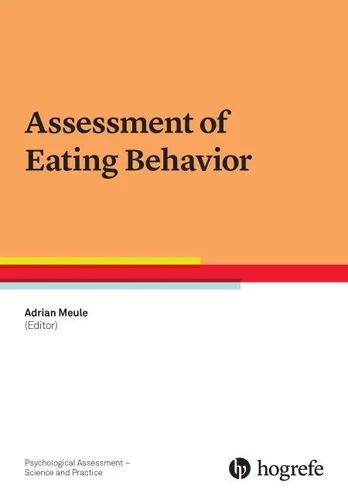
Assessment of Eating Behavior
Par :Formats :
Disponible dans votre compte client Decitre ou Furet du Nord dès validation de votre commande. Le format ePub est :
- Compatible avec une lecture sur My Vivlio (smartphone, tablette, ordinateur)
- Compatible avec une lecture sur liseuses Vivlio
- Pour les liseuses autres que Vivlio, vous devez utiliser le logiciel Adobe Digital Edition. Non compatible avec la lecture sur les liseuses Kindle, Remarkable et Sony
 , qui est-ce ?
Notre partenaire de plateforme de lecture numérique où vous retrouverez l'ensemble de vos ebooks gratuitement
Pour en savoir plus sur nos ebooks, consultez notre aide en ligne ici
C'est si simple ! Lisez votre ebook avec l'app Vivlio sur votre tablette, mobile ou ordinateur :

- Nombre de pages300
- FormatePub
- ISBN978-1-61334-616-7
- EAN9781613346167
- Date de parution08/05/2023
- Protection num.Digital Watermarking
- Taille4 Mo
- Infos supplémentairesepub
- ÉditeurHogrefe Publishing
Résumé
Eating behavior encompasses a broad range of aspects: from under- to overeating and from normal to pathological eating. The expert contributors to this volume provide a comprehensive overview of assessment methods for eating behavior research and clinical practice, which include both self-report questionnaires and structured interviews as well as assessment of food intake in the laboratory, ecological momentary assessment, cognitive-behavioral tasks, and psychophysiological measures.
They explore the assessment of eating disorders such as anorexia nervosa, bulimia nervosa, binge-eating disorder, and others. They also address topics that may be associated with disordered eating and obesity but are also relevant in persons without these conditions, such as restrained eating and dieting, emotional eating, food craving and food "addiction, " orthorexia nervosa, intuitive and mindful eating, and grazing.
Further topics that are strongly connected to eating behavior such as body image, physical activity, body composition and expenditure, food neophobia and disgust sensitivity, and weight-related stigmatization are also examined. This book is essential reading for researchers working in clinical and health psychology, consumer psychology, psychiatry, and nutrition science as well as practitioners, including psychotherapists, physicians, nutrition counsellors, who assess eating behavior and related aspects in their daily work.
They explore the assessment of eating disorders such as anorexia nervosa, bulimia nervosa, binge-eating disorder, and others. They also address topics that may be associated with disordered eating and obesity but are also relevant in persons without these conditions, such as restrained eating and dieting, emotional eating, food craving and food "addiction, " orthorexia nervosa, intuitive and mindful eating, and grazing.
Further topics that are strongly connected to eating behavior such as body image, physical activity, body composition and expenditure, food neophobia and disgust sensitivity, and weight-related stigmatization are also examined. This book is essential reading for researchers working in clinical and health psychology, consumer psychology, psychiatry, and nutrition science as well as practitioners, including psychotherapists, physicians, nutrition counsellors, who assess eating behavior and related aspects in their daily work.
A propos de Adrian Meule

19,99 €