SOLDES
Jusqu'à -70% sur une sélection d'articles*

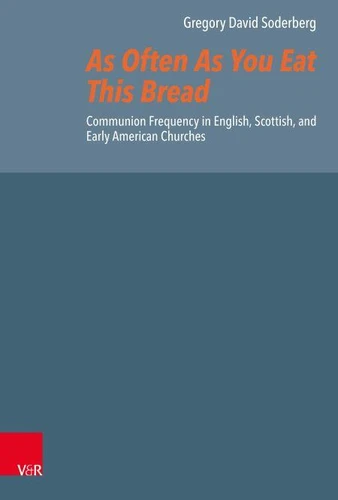
As Often As You Eat This Bread. Communion Frequency in English, Scottish, and Early American Churches
Par :Formats :
Disponible dans votre compte client Decitre ou Furet du Nord dès validation de votre commande. Le format PDF est :
- Compatible avec une lecture sur My Vivlio (smartphone, tablette, ordinateur)
- Compatible avec une lecture sur liseuses Vivlio
- Pour les liseuses autres que Vivlio, vous devez utiliser le logiciel Adobe Digital Edition. Non compatible avec la lecture sur les liseuses Kindle, Remarkable et Sony
 , qui est-ce ?
Notre partenaire de plateforme de lecture numérique où vous retrouverez l'ensemble de vos ebooks gratuitement
Pour en savoir plus sur nos ebooks, consultez notre aide en ligne ici
C'est si simple ! Lisez votre ebook avec l'app Vivlio sur votre tablette, mobile ou ordinateur :

- Nombre de pages280
- FormatPDF
- ISBN978-3-647-56070-0
- EAN9783647560700
- Date de parution14/11/2022
- Protection num.pas de protection
- Taille3 Mo
- Infos supplémentairespdf
- ÉditeurVandenhoeck & Ruprecht
Résumé
Why can't Christians agree about communion? Why is it that in some churches all worship services culminate in a holy meal whereas other churches celebrate this "holy supper" only once in a while? Theologian Gregory Soderberg has researched this question, excavating patterns of communion frequency within one of the bigger Christian families: the Reformed tradition. Despite being the sacrament of unity, the eucharist has often been a cause of strife in Christian churches.
In his study, Gregory David Soderberg is the first to focus in depth on communion frequency in the Reformed tradition.
He concludes that, although the 16th century Reformers desired more frequent communion, this was balanced by their desire to create mature Christian communities. So, preachers and church leaders stressed the priority of moral conduct and the importance of understanding what the eucharist meant for Protestants. The study analyses sources from the very beginnings of this tradition in 16th century Zürich and Geneva, and it follows its trajectories through England and Scotland all the way down to 19th century USA.
Ultimately, it is hoped that understanding the polemics of the past will help churches today to celebrate the sacrament of unity more meaningfully.
He concludes that, although the 16th century Reformers desired more frequent communion, this was balanced by their desire to create mature Christian communities. So, preachers and church leaders stressed the priority of moral conduct and the importance of understanding what the eucharist meant for Protestants. The study analyses sources from the very beginnings of this tradition in 16th century Zürich and Geneva, and it follows its trajectories through England and Scotland all the way down to 19th century USA.
Ultimately, it is hoped that understanding the polemics of the past will help churches today to celebrate the sacrament of unity more meaningfully.