
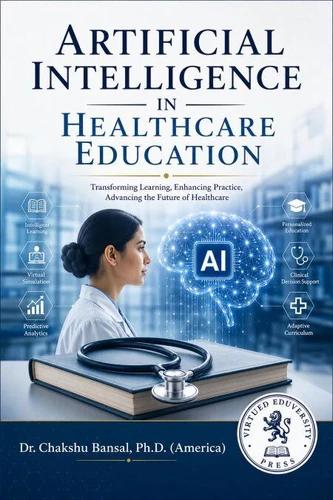
Artificial Intelligence in Healthcare Education
Par :Formats :
Disponible dans votre compte client Decitre ou Furet du Nord dès validation de votre commande. Le format ePub est :
- Compatible avec une lecture sur My Vivlio (smartphone, tablette, ordinateur)
- Compatible avec une lecture sur liseuses Vivlio
- Pour les liseuses autres que Vivlio, vous devez utiliser le logiciel Adobe Digital Edition. Non compatible avec la lecture sur les liseuses Kindle, Remarkable et Sony
 , qui est-ce ?
Notre partenaire de plateforme de lecture numérique où vous retrouverez l'ensemble de vos ebooks gratuitement
Pour en savoir plus sur nos ebooks, consultez notre aide en ligne ici
C'est si simple ! Lisez votre ebook avec l'app Vivlio sur votre tablette, mobile ou ordinateur :

- FormatePub
- ISBN8235917002
- EAN9798235917002
- Date de parution27/05/2026
- Protection num.pas de protection
- Infos supplémentairesepub
- ÉditeurIoakim Ioakim
Résumé
Artificial Intelligence in Healthcare Education is a timely and practical guide for educators, clinicians, academic leaders, and healthcare institutions seeking to understand how artificial intelligence is transforming the future of medical and healthcare training. Bridging the gap between emerging AI technologies and real-world educational practice, this book offers a comprehensive exploration of how AI can enhance teaching, learning, assessment, curriculum design, and clinical competency development across healthcare professions.
Beginning with an accessible introduction to artificial intelligence and its evolution in medicine, the book explains the key AI concepts healthcare educators need to understand without requiring a technical background. Readers are guided through the changing landscape of healthcare education, including the growing pressures on institutions, the importance of digital literacy, and the need to prepare students for AI-enabled clinical environments.
The book critically examines AI-powered learning tools such as adaptive learning platforms, large language models, virtual simulations, and diagnostic support systems. It evaluates what works, what does not, and how educators can responsibly integrate these technologies into teaching practice. Special attention is given to the limitations of AI in clinical diagnostics and the importance of teaching students to collaborate effectively with AI systems while maintaining human judgment, empathy, and ethical responsibility.
A major focus of the text is curriculum transformation for the AI age. Readers will discover practical models for AI-integrated curricula, competency frameworks, and case studies demonstrating successful implementation strategies in healthcare education settings. The book also addresses one of the most urgent challenges facing educators today: assessment in an AI-enabled world. It explores academic integrity, robust assessment approaches, and methods for redesigning evaluation systems in response to generative AI technologies.
Ethics, equity, and inclusivity remain central themes throughout the book. Dedicated chapters discuss algorithmic bias, ethical frameworks, fairness in AI-driven education, and the irreplaceable human dimension of healthcare practice and learning. Global perspectives from the United Kingdom, South Asia, and Commonwealth contexts provide an international understanding of how healthcare education systems are adapting to AI-driven change.
Designed for medical educators, nursing faculty, allied health instructors, healthcare administrators, policymakers, researchers, and postgraduate students, Artificial Intelligence in Healthcare Education combines academic insight with practical guidance. With appendices that include a glossary of AI terminology and a critical appraisal checklist for AI studies in healthcare education, the book serves as both an introductory reference and a strategic roadmap for institutions preparing for the future of healthcare learning.
Whether you are exploring AI for the first time or seeking evidence-based strategies for implementation, this book provides the knowledge, frameworks, and critical perspectives needed to navigate the rapidly evolving intersection of artificial intelligence and healthcare education.
Beginning with an accessible introduction to artificial intelligence and its evolution in medicine, the book explains the key AI concepts healthcare educators need to understand without requiring a technical background. Readers are guided through the changing landscape of healthcare education, including the growing pressures on institutions, the importance of digital literacy, and the need to prepare students for AI-enabled clinical environments.
The book critically examines AI-powered learning tools such as adaptive learning platforms, large language models, virtual simulations, and diagnostic support systems. It evaluates what works, what does not, and how educators can responsibly integrate these technologies into teaching practice. Special attention is given to the limitations of AI in clinical diagnostics and the importance of teaching students to collaborate effectively with AI systems while maintaining human judgment, empathy, and ethical responsibility.
A major focus of the text is curriculum transformation for the AI age. Readers will discover practical models for AI-integrated curricula, competency frameworks, and case studies demonstrating successful implementation strategies in healthcare education settings. The book also addresses one of the most urgent challenges facing educators today: assessment in an AI-enabled world. It explores academic integrity, robust assessment approaches, and methods for redesigning evaluation systems in response to generative AI technologies.
Ethics, equity, and inclusivity remain central themes throughout the book. Dedicated chapters discuss algorithmic bias, ethical frameworks, fairness in AI-driven education, and the irreplaceable human dimension of healthcare practice and learning. Global perspectives from the United Kingdom, South Asia, and Commonwealth contexts provide an international understanding of how healthcare education systems are adapting to AI-driven change.
Designed for medical educators, nursing faculty, allied health instructors, healthcare administrators, policymakers, researchers, and postgraduate students, Artificial Intelligence in Healthcare Education combines academic insight with practical guidance. With appendices that include a glossary of AI terminology and a critical appraisal checklist for AI studies in healthcare education, the book serves as both an introductory reference and a strategic roadmap for institutions preparing for the future of healthcare learning.
Whether you are exploring AI for the first time or seeking evidence-based strategies for implementation, this book provides the knowledge, frameworks, and critical perspectives needed to navigate the rapidly evolving intersection of artificial intelligence and healthcare education.