OFFRE LISEUSES
Une liseuse achetée = une housse offerte* jusqu'au 21 juin

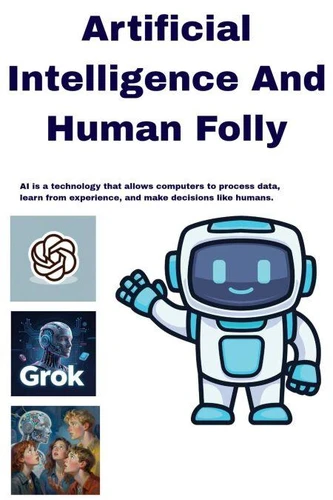
Artificial Intelligence And Human Folly
Par :Formats :
Disponible dans votre compte client Decitre ou Furet du Nord dès validation de votre commande. Le format ePub est :
- Compatible avec une lecture sur My Vivlio (smartphone, tablette, ordinateur)
- Compatible avec une lecture sur liseuses Vivlio
- Pour les liseuses autres que Vivlio, vous devez utiliser le logiciel Adobe Digital Edition. Non compatible avec la lecture sur les liseuses Kindle, Remarkable et Sony
 , qui est-ce ?
Notre partenaire de plateforme de lecture numérique où vous retrouverez l'ensemble de vos ebooks gratuitement
Pour en savoir plus sur nos ebooks, consultez notre aide en ligne ici
C'est si simple ! Lisez votre ebook avec l'app Vivlio sur votre tablette, mobile ou ordinateur :

- FormatePub
- ISBN8201861933
- EAN9798201861933
- Date de parution30/01/2026
- Protection num.pas de protection
- Infos supplémentairesepub
- ÉditeurJL
Résumé
Artificial Intelligence and Human Folly is a provocative, accessible exploration of one of the defining questions of our age: what happens when human intelligence is slowly outsourced to machines? This e-book does not argue against AI itself, but against the uncritical, excessive reliance on it-and the quiet erosion of human judgment that follows. As artificial intelligence becomes faster, cheaper, and more persuasive, it increasingly shapes how we think, decide, create, and relate to one another.
From automated decision-making and predictive algorithms to AI-generated art, writing, and relationships, convenience has begun to replace effort. This book argues that while AI can amplify human capability, overuse dulls essential human skills: critical thinking, moral reasoning, creativity, patience, and responsibility. Drawing on philosophy, psychology, history, and real-world examples, Artificial Intelligence and Human Folly shows how dependence on AI can lead to intellectual laziness, loss of agency, and a dangerous illusion of objectivity.
Machines do not understand truth, values, or consequences-yet humans increasingly defer to them as if they do. When algorithms decide what we see, believe, and choose, human error is not eliminated; it is merely hidden behind technical complexity. The e-book also explores bigger risks: the weakening of empathy through automated interaction, the narrowing of imagination through algorithmic optimization, and the moral hazard of delegating ethical decisions to systems that cannot be held accountable.
It warns that a society that stops thinking for itself becomes easy to manipulate, govern, and control. Ultimately, this book is a call for balance. It challenges readers to reclaim intentional thinking, to treat AI as a tool rather than a guide, and to recognize that intelligence without wisdom is not progress. Artificial Intelligence and Human Folly is essential reading for anyone concerned about the future of human autonomy in an automated world.
From automated decision-making and predictive algorithms to AI-generated art, writing, and relationships, convenience has begun to replace effort. This book argues that while AI can amplify human capability, overuse dulls essential human skills: critical thinking, moral reasoning, creativity, patience, and responsibility. Drawing on philosophy, psychology, history, and real-world examples, Artificial Intelligence and Human Folly shows how dependence on AI can lead to intellectual laziness, loss of agency, and a dangerous illusion of objectivity.
Machines do not understand truth, values, or consequences-yet humans increasingly defer to them as if they do. When algorithms decide what we see, believe, and choose, human error is not eliminated; it is merely hidden behind technical complexity. The e-book also explores bigger risks: the weakening of empathy through automated interaction, the narrowing of imagination through algorithmic optimization, and the moral hazard of delegating ethical decisions to systems that cannot be held accountable.
It warns that a society that stops thinking for itself becomes easy to manipulate, govern, and control. Ultimately, this book is a call for balance. It challenges readers to reclaim intentional thinking, to treat AI as a tool rather than a guide, and to recognize that intelligence without wisdom is not progress. Artificial Intelligence and Human Folly is essential reading for anyone concerned about the future of human autonomy in an automated world.