OFFRE LISEUSES
Une liseuse achetée = une housse offerte* jusqu'au 21 juin

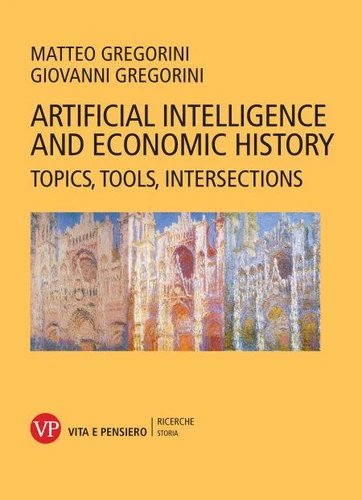
Artificial Intelligence and Economic History. Topics, tools, intersections
Par : ,Formats :
Disponible dans votre compte client Decitre ou Furet du Nord dès validation de votre commande. Le format PDF est :
- Compatible avec une lecture sur My Vivlio (smartphone, tablette, ordinateur)
- Compatible avec une lecture sur liseuses Vivlio
- Pour les liseuses autres que Vivlio, vous devez utiliser le logiciel Adobe Digital Edition. Non compatible avec la lecture sur les liseuses Kindle, Remarkable et Sony
 , qui est-ce ?
Notre partenaire de plateforme de lecture numérique où vous retrouverez l'ensemble de vos ebooks gratuitement
Pour en savoir plus sur nos ebooks, consultez notre aide en ligne ici
C'est si simple ! Lisez votre ebook avec l'app Vivlio sur votre tablette, mobile ou ordinateur :

- Nombre de pages156
- FormatPDF
- ISBN978-88-343-5727-9
- EAN9788834357279
- Date de parution10/12/2024
- Protection num.Digital Watermarking
- Taille14 Mo
- Infos supplémentairespdf
- ÉditeurVita e pensiero
Résumé
Artificial Intelligence and Society are ever so increasingly connected, both in magnitude and in frequency. The very same holds true for history, particularly for economic and social history, that is now interpreting and studying the past with Machine Learning, in the form of Social Network Analysis, Time Series Analysis, or even yet Cluster Analysis. Applications of these tools in the historiographical field are indeed necessary to assess the full extent of the entanglement between historical-critical method and quantitative analysis (descriptive, inferential and generative).
This book wishes to lay grounds in this very direction, by juxtaposing different ways of investigating economic history, also from a methodological perspective: the aforementioned Time Series Analysis, Environmental History, Accounting History, Financial History, particularly of ecclesiastic organizations (which in turn renders it Charity History).
This book wishes to lay grounds in this very direction, by juxtaposing different ways of investigating economic history, also from a methodological perspective: the aforementioned Time Series Analysis, Environmental History, Accounting History, Financial History, particularly of ecclesiastic organizations (which in turn renders it Charity History).
A propos de Giovanni Gregorini
15,99 €

14,99 €