
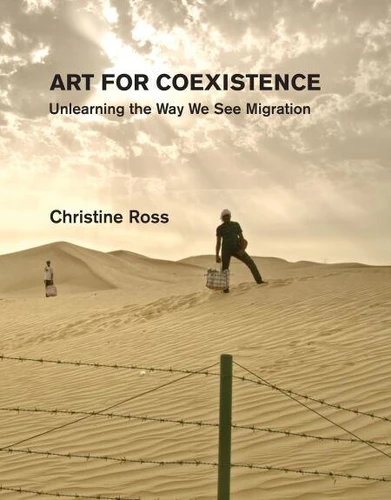
Art for Coexistence. Unlearning the Way We See Migration
Par :Formats :
Disponible dans votre compte client Decitre ou Furet du Nord dès validation de votre commande. Le format ePub protégé est :
- Compatible avec une lecture sur My Vivlio (smartphone, tablette, ordinateur)
- Compatible avec une lecture sur liseuses Vivlio
- Pour les liseuses autres que Vivlio, vous devez utiliser le logiciel Adobe Digital Edition. Non compatible avec la lecture sur les liseuses Kindle, Remarkable et Sony
- Non compatible avec un achat hors France métropolitaine
 , qui est-ce ?
Notre partenaire de plateforme de lecture numérique où vous retrouverez l'ensemble de vos ebooks gratuitement
Pour en savoir plus sur nos ebooks, consultez notre aide en ligne ici
C'est si simple ! Lisez votre ebook avec l'app Vivlio sur votre tablette, mobile ou ordinateur :

- Nombre de pages424
- FormatePub
- ISBN978-0-262-37162-9
- EAN9780262371629
- Date de parution22/11/2022
- Protection num.Adobe DRM
- Taille4 Mo
- Infos supplémentairesepub
- ÉditeurThe MIT Press
Résumé
An exploration of how contemporary art reframes and humanizes migration, calling for coexistence-the recognition of the interdependence of beings. In Art for Coexistence, art historian Christine Ross examines contemporary art's response to migration, showing that art invites us to abandon our preconceptions about the current "crisis"-to unlearn them-and to see migration more critically, more disobediently.
We (viewers in Europe and North America) must come to see migration in terms of coexistence: the interdependence of beings. The artworks explored by Ross reveal, contest, rethink, delink, and relink more reciprocally the interdependencies shaping migration today-connecting citizens-on-the-move from some of the poorest countries and acknowledged citizens of some of the wealthiest countries and democracies worldwide. These installations, videos, virtual reality works, webcasts, sculptures, graffiti, paintings, photographs, and a rescue boat, by artists including Banksy, Ai Weiwei, Alejandro González Iñárritu, Laura Waddington, Tania Bruguera, and others, demonstrate art's power to mediate experiences of migration.
Ross argues that art invents a set of interconnected calls for more mutual forms of coexistence: to historicize, to become responsible, to empathize, and to story-tell. Art history, Ross tells us, must discard the legacy of imperialist museology-which dissocializes, dehistoricizes, and depoliticizes art. It must reinvent itself, engaging with political philosophy, postcolonial, decolonial, Black, and Indigenous studies, and critical refugee and migrant studies.
We (viewers in Europe and North America) must come to see migration in terms of coexistence: the interdependence of beings. The artworks explored by Ross reveal, contest, rethink, delink, and relink more reciprocally the interdependencies shaping migration today-connecting citizens-on-the-move from some of the poorest countries and acknowledged citizens of some of the wealthiest countries and democracies worldwide. These installations, videos, virtual reality works, webcasts, sculptures, graffiti, paintings, photographs, and a rescue boat, by artists including Banksy, Ai Weiwei, Alejandro González Iñárritu, Laura Waddington, Tania Bruguera, and others, demonstrate art's power to mediate experiences of migration.
Ross argues that art invents a set of interconnected calls for more mutual forms of coexistence: to historicize, to become responsible, to empathize, and to story-tell. Art history, Ross tells us, must discard the legacy of imperialist museology-which dissocializes, dehistoricizes, and depoliticizes art. It must reinvent itself, engaging with political philosophy, postcolonial, decolonial, Black, and Indigenous studies, and critical refugee and migrant studies.