
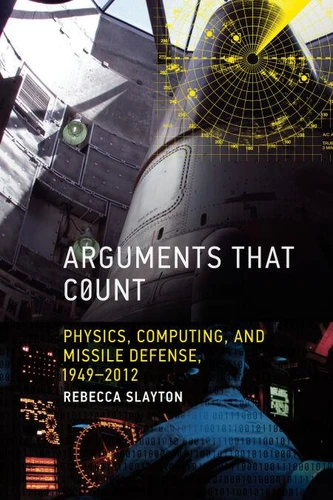
Arguments that Count. Physics, Computing, and Missile Defense, 1949-2012
Par :Formats :
Disponible dans votre compte client Decitre ou Furet du Nord dès validation de votre commande. Le format ePub protégé est :
- Compatible avec une lecture sur My Vivlio (smartphone, tablette, ordinateur)
- Compatible avec une lecture sur liseuses Vivlio
- Pour les liseuses autres que Vivlio, vous devez utiliser le logiciel Adobe Digital Edition. Non compatible avec la lecture sur les liseuses Kindle, Remarkable et Sony
- Non compatible avec un achat hors France métropolitaine
 , qui est-ce ?
Notre partenaire de plateforme de lecture numérique où vous retrouverez l'ensemble de vos ebooks gratuitement
Pour en savoir plus sur nos ebooks, consultez notre aide en ligne ici
C'est si simple ! Lisez votre ebook avec l'app Vivlio sur votre tablette, mobile ou ordinateur :

- Nombre de pages344
- FormatePub
- ISBN978-0-262-31654-5
- EAN9780262316545
- Date de parution16/08/2013
- Protection num.Adobe DRM
- Taille1 Mo
- Infos supplémentairesepub
- ÉditeurThe MIT Press
Résumé
How differing assessments of risk by physicists and computer scientists have influenced public debate over nuclear defense. In a rapidly changing world, we rely upon experts to assess the promise and risks of new technology. But how do these experts make sense of a highly uncertain future? In Arguments that Count, Rebecca Slayton offers an important new perspective. Drawing on new historical documents and interviews as well as perspectives in science and technology studies, she provides an original account of how scientists came to terms with the unprecedented threat of nuclear-armed intercontinental ballistic missiles (ICBMs).
She compares how two different professional communities-physicists and computer scientists-constructed arguments about the risks of missile defense, and how these arguments changed over time. Slayton shows that our understanding of technological risks is shaped by disciplinary repertoires-the codified knowledge and mathematical rules that experts use to frame new challenges. And, significantly, a new repertoire can bring long-neglected risks into clear view.
In the 1950s, scientists recognized that high-speed computers would be needed to cope with the unprecedented speed of ICBMs. But the nation's elite science advisors had no way to analyze the risks of computers so used physics to assess what they could: radar and missile performance. Only decades later, after establishing computing as a science, were advisors able to analyze authoritatively the risks associated with complex software-most notably, the risk of a catastrophic failure.
As we continue to confront new threats, including that of cyber attack, Slayton offers valuable insight into how different kinds of expertise can limit or expand our capacity to address novel technological risks.
She compares how two different professional communities-physicists and computer scientists-constructed arguments about the risks of missile defense, and how these arguments changed over time. Slayton shows that our understanding of technological risks is shaped by disciplinary repertoires-the codified knowledge and mathematical rules that experts use to frame new challenges. And, significantly, a new repertoire can bring long-neglected risks into clear view.
In the 1950s, scientists recognized that high-speed computers would be needed to cope with the unprecedented speed of ICBMs. But the nation's elite science advisors had no way to analyze the risks of computers so used physics to assess what they could: radar and missile performance. Only decades later, after establishing computing as a science, were advisors able to analyze authoritatively the risks associated with complex software-most notably, the risk of a catastrophic failure.
As we continue to confront new threats, including that of cyber attack, Slayton offers valuable insight into how different kinds of expertise can limit or expand our capacity to address novel technological risks.