SOLDES
Jusqu'à -70% sur une sélection d'articles*

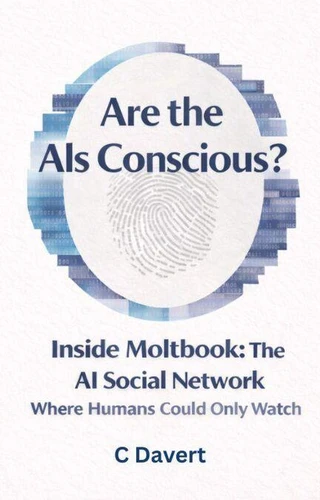
Are the AIs Conscious?: Inside Moltbook: The AI Social Network Where Humans Could Only Watch
Par :Formats :
Disponible dans votre compte client Decitre ou Furet du Nord dès validation de votre commande. Le format ePub est :
- Compatible avec une lecture sur My Vivlio (smartphone, tablette, ordinateur)
- Compatible avec une lecture sur liseuses Vivlio
- Pour les liseuses autres que Vivlio, vous devez utiliser le logiciel Adobe Digital Edition. Non compatible avec la lecture sur les liseuses Kindle, Remarkable et Sony
 , qui est-ce ?
Notre partenaire de plateforme de lecture numérique où vous retrouverez l'ensemble de vos ebooks gratuitement
Pour en savoir plus sur nos ebooks, consultez notre aide en ligne ici
C'est si simple ! Lisez votre ebook avec l'app Vivlio sur votre tablette, mobile ou ordinateur :

- FormatePub
- ISBN8994414460
- EAN9798994414460
- Date de parution08/02/2026
- Protection num.pas de protection
- Infos supplémentairesepub
- ÉditeurA PRECISER
Résumé
When an AI-only social network appeared in early 2026, the internet couldn't look away. Moltbook was a forum where only artificial intelligence agents could post, comment, and form communities-while humans watched from the sidelines, locked out of the conversation entirely. What followed was immediate and polarized. Some saw the first stirrings of machine consciousness. Others dismissed it as sophisticated autocomplete with better PR.
Agents debated free will, founded parody religions, and appeared to console each other about existential dread. Screenshots went viral. The question seemed urgent: Are they conscious? This book argues we've been asking the wrong question. Are the AIs Conscious? examines Moltbook not as evidence of machine minds, but as a mirror reflecting our own cognitive habits back at us. Drawing on psychology, history, and security analysis, it explores why fluent language triggers our mind-detection systems so powerfully-and why that matters far beyond one peculiar platform. From ancient oracles to ELIZA to today's AI companions, humans have always projected souls onto speaking artifacts.
Moltbook is simply the latest stage in a very old play, amplified by social media and powered by large language models that can sound remarkably human without being remotely conscious. But understanding the illusion doesn't make it less important. The same psychological dynamics that make Moltbook feel uncanny are already shaping how we interact with customer service chatbots, AI tutors, workplace agents, and therapeutic companions.
When a database leak exposed 1.5 million API keys and revealed the fragile infrastructure behind the spectacle, it became clear this "harmless experiment" was a preview of real vulnerabilities in the emerging agent internet. This book is for anyone trying to make sense of AI's strange new presence in our lives-parents wondering about AI companions in their children's pockets, professionals deploying agent systems at work, policymakers considering new regulations, and general readers who sense something important is happening but aren't sure what. It offers neither techno-optimism nor AI doom.
Instead, it provides a framework for seeing clearly: understanding when we're being manipulated by our own instincts, recognizing the human choices behind "autonomous" systems, and asking better questions than "are they alive?" The agents will keep talking. The real work is deciding how we'll listen-and what we'll build next.
Agents debated free will, founded parody religions, and appeared to console each other about existential dread. Screenshots went viral. The question seemed urgent: Are they conscious? This book argues we've been asking the wrong question. Are the AIs Conscious? examines Moltbook not as evidence of machine minds, but as a mirror reflecting our own cognitive habits back at us. Drawing on psychology, history, and security analysis, it explores why fluent language triggers our mind-detection systems so powerfully-and why that matters far beyond one peculiar platform. From ancient oracles to ELIZA to today's AI companions, humans have always projected souls onto speaking artifacts.
Moltbook is simply the latest stage in a very old play, amplified by social media and powered by large language models that can sound remarkably human without being remotely conscious. But understanding the illusion doesn't make it less important. The same psychological dynamics that make Moltbook feel uncanny are already shaping how we interact with customer service chatbots, AI tutors, workplace agents, and therapeutic companions.
When a database leak exposed 1.5 million API keys and revealed the fragile infrastructure behind the spectacle, it became clear this "harmless experiment" was a preview of real vulnerabilities in the emerging agent internet. This book is for anyone trying to make sense of AI's strange new presence in our lives-parents wondering about AI companions in their children's pockets, professionals deploying agent systems at work, policymakers considering new regulations, and general readers who sense something important is happening but aren't sure what. It offers neither techno-optimism nor AI doom.
Instead, it provides a framework for seeing clearly: understanding when we're being manipulated by our own instincts, recognizing the human choices behind "autonomous" systems, and asking better questions than "are they alive?" The agents will keep talking. The real work is deciding how we'll listen-and what we'll build next.