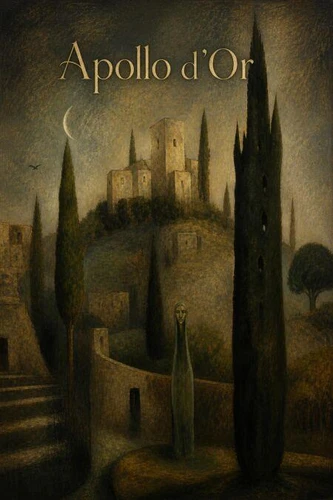
Apollo d'Or is a Romanian visionary novella about a young man sent away to a remote mountain village after a collapse of the soul. There, among mist, orchards, animals, rural rituals, and the strange radiance of summer, he discovers Dumbrava de Aur - the Golden Grove - and Tomino, a fragile, hooded boy whose presence transforms shame, loneliness, desire, illness, and beauty into a private solar mythology.
Written in a feverish, lyrical voice, Apollo d'Or moves between rural realism and sacred hallucination, between childhood wound and adult longing, between the body's humiliation and the soul's impossible hunger for radiance. The Golden Grove becomes more than a place: it becomes an inner temple, a lost paradise, a wound of light that can never be fully recovered. This English literary edition preserves the symbolic density, emotional intensity, and visionary rhythm of the Romanian original.
Apollo d'Or is a Romanian visionary novella about a young man sent away to a remote mountain village after a collapse of the soul. There, among mist, orchards, animals, rural rituals, and the strange radiance of summer, he discovers Dumbrava de Aur - the Golden Grove - and Tomino, a fragile, hooded boy whose presence transforms shame, loneliness, desire, illness, and beauty into a private solar mythology.
Written in a feverish, lyrical voice, Apollo d'Or moves between rural realism and sacred hallucination, between childhood wound and adult longing, between the body's humiliation and the soul's impossible hunger for radiance. The Golden Grove becomes more than a place: it becomes an inner temple, a lost paradise, a wound of light that can never be fully recovered. This English literary edition preserves the symbolic density, emotional intensity, and visionary rhythm of the Romanian original.

 , qui est-ce ?