SOLDES
Jusqu'à -70% sur une sélection d'articles*

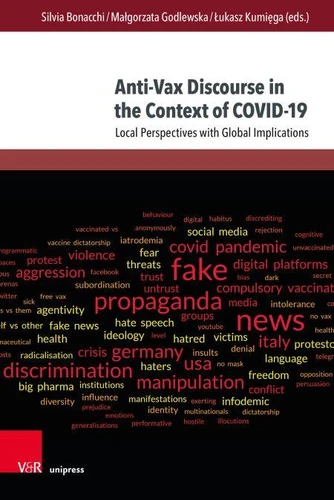
Anti-Vax Discourse in the Context of COVID-19. Local Perspectives with Global Implications
Par : , , , ,Formats :
Disponible dans votre compte client Decitre ou Furet du Nord dès validation de votre commande. Le format PDF est :
- Compatible avec une lecture sur My Vivlio (smartphone, tablette, ordinateur)
- Compatible avec une lecture sur liseuses Vivlio
- Pour les liseuses autres que Vivlio, vous devez utiliser le logiciel Adobe Digital Edition. Non compatible avec la lecture sur les liseuses Kindle, Remarkable et Sony
 , qui est-ce ?
Notre partenaire de plateforme de lecture numérique où vous retrouverez l'ensemble de vos ebooks gratuitement
Pour en savoir plus sur nos ebooks, consultez notre aide en ligne ici
C'est si simple ! Lisez votre ebook avec l'app Vivlio sur votre tablette, mobile ou ordinateur :

- Nombre de pages212
- FormatPDF
- ISBN978-3-8470-1881-0
- EAN9783847018810
- Date de parution13/10/2025
- Protection num.pas de protection
- Taille2 Mo
- Infos supplémentairespdf
- ÉditeurV&R Unipress
Résumé
COVID-19 had an enormous impact on society around the globe. By 5th March 2023, when the WHO officially declared the pandemic emergency over, societies affected by it had been profoundly changed. The COVID-19 pandemic not only had medical consequences, but also significant effects related to the mechanisms involved in its discursive construction as a phenomenon of wide significance in various social arenas.
Reaching a highly polarized form, public debate on compulsory vaccination against COVID-19 constituted an essential component of mechanisms not only for stance-taking, for creating opportunities for self- and other-positioning, and for covering discursive positions, but also for subverting existing epistemic orders. The present volume reconstructs this complex discursive phenomenon with examples from Italy, Germany and the USA, and invites critical reflections on the way societies around the globe have faced the extreme crisis sparked by the pandemic.
Reaching a highly polarized form, public debate on compulsory vaccination against COVID-19 constituted an essential component of mechanisms not only for stance-taking, for creating opportunities for self- and other-positioning, and for covering discursive positions, but also for subverting existing epistemic orders. The present volume reconstructs this complex discursive phenomenon with examples from Italy, Germany and the USA, and invites critical reflections on the way societies around the globe have faced the extreme crisis sparked by the pandemic.