James H. Richardson is Lecturer in Classics at Massey University.
Federico Santangelo is Professor of Ancient History at Newcastle University.
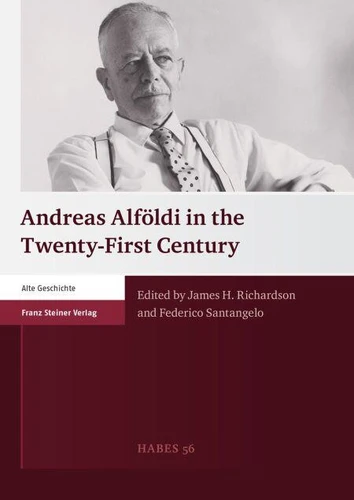
Andreas Alföldi in the Twenty-First Century
Par : ,Formats :
Disponible dans votre compte client Decitre ou Furet du Nord dès validation de votre commande. Le format PDF est :
- Compatible avec une lecture sur My Vivlio (smartphone, tablette, ordinateur)
- Compatible avec une lecture sur liseuses Vivlio
- Pour les liseuses autres que Vivlio, vous devez utiliser le logiciel Adobe Digital Edition. Non compatible avec la lecture sur les liseuses Kindle, Remarkable et Sony
 , qui est-ce ?
Notre partenaire de plateforme de lecture numérique où vous retrouverez l'ensemble de vos ebooks gratuitement
Pour en savoir plus sur nos ebooks, consultez notre aide en ligne ici
C'est si simple ! Lisez votre ebook avec l'app Vivlio sur votre tablette, mobile ou ordinateur :

- Nombre de pages327
- FormatPDF
- ISBN978-3-515-10968-0
- EAN9783515109680
- Date de parution05/03/2015
- Protection num.Digital Watermarking
- Taille3 Mo
- Infos supplémentairespdf
- ÉditeurFranz Steiner
Résumé
Andreas Alföldi (1895-1981) was an eminent ancient historian, numismatist, archaeologist and epigraphist. His scholarly output, as vast as it was diverse, covered archaic Rome, the late Republic, the provinces of the Roman Empire, especially the Danube region, and late antiquity. Alföldi's work was marked by extraordinary erudition, by his ability to draw on all manner of evidence, no matter how disparate, and by astonishing fertility and originality, and yet, while a number of his publications remain influential, others - some of which were controversial even when they first appeared - are now largely ignored.
This volume, which comes some thirty years after Alföldi's death and a century after his first publication (at just 19 years of age), contains a collection of papers that shed light on Alföldi's life and discuss his work on a variety of topics, from earliest Rome to late antiquity. It offers a wide-ranging assessment of Alföldi's arguments and ideas, both those that have been influential and those that have been superseded or neglected, and explores an academic career that began in Alföldi's native Hungary and ended in exile in the United States.
This volume, which comes some thirty years after Alföldi's death and a century after his first publication (at just 19 years of age), contains a collection of papers that shed light on Alföldi's life and discuss his work on a variety of topics, from earliest Rome to late antiquity. It offers a wide-ranging assessment of Alföldi's arguments and ideas, both those that have been influential and those that have been superseded or neglected, and explores an academic career that began in Alföldi's native Hungary and ended in exile in the United States.