
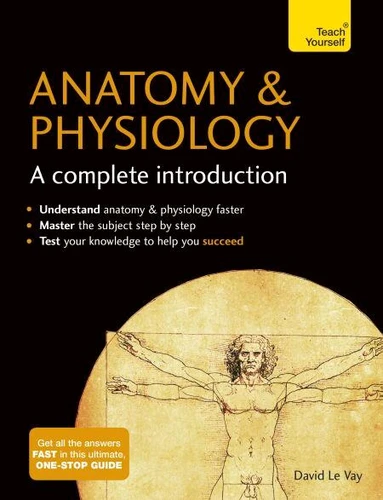
Anatomy & Physiology: A Complete Introduction: Teach Yourself
Par :Formats :
Disponible dans votre compte client Decitre ou Furet du Nord dès validation de votre commande. Le format ePub protégé est :
- Compatible avec une lecture sur My Vivlio (smartphone, tablette, ordinateur)
- Compatible avec une lecture sur liseuses Vivlio
- Pour les liseuses autres que Vivlio, vous devez utiliser le logiciel Adobe Digital Edition. Non compatible avec la lecture sur les liseuses Kindle, Remarkable et Sony
- Non compatible avec un achat hors France métropolitaine
 , qui est-ce ?
Notre partenaire de plateforme de lecture numérique où vous retrouverez l'ensemble de vos ebooks gratuitement
Pour en savoir plus sur nos ebooks, consultez notre aide en ligne ici
C'est si simple ! Lisez votre ebook avec l'app Vivlio sur votre tablette, mobile ou ordinateur :

- Nombre de pages288
- FormatePub
- ISBN978-1-4736-0867-2
- EAN9781473608672
- Date de parution07/10/2015
- Protection num.Adobe DRM
- Infos supplémentairesepub
- ÉditeurTeach Yourself
Résumé
Anatomy & Physiology: A Complete Introduction is designed to give you everything you need to succeed, all in one place. It covers the key areas that students are expected to be confident in, outlining the basics in clear, jargon-free English and providing added-value features like summaries of key books and even lists of questions you might be asked in your seminar or exam. The book uses a structure that mirrors the way anatomy & physiology is taught on many university courses, providing a comprehensive introduction to the structure and function of the human body.
Extensively illustrated, the book also covers modern methods of investigation, relevant aspects of modern genetics, sports injuries, environmental and evolutionary considerations, and the physiological aspects of AIDS. Topics covered include: cells and tissues; the skeleton; muscle; body coverings and body systems; the upper limb; the lower limb; the abdomen; the thorax; the head and neck; basic biophysics and chemistry; foodstuffs and vitamins; digestion; absorption, utilization and storage of digested food; blood, lymph and reticuloendothelial (immune) system; the heart and circulation; respiration; excretion; nervous system and sense organs; the endocrine system; reproduction and development; environmental considerations; evolution.
Anatomy & Physiology employs the 'Breakthrough Method' to help you advance quickly at any subject, whether you're studing for an exam or just for your own interst. The Breakthrough Method is designed to overcome typical problems you'll face as learn new concepts and skills.- Problem: "I find it difficult to remember what I've read."; Solution: this book includes end-of-chapter summaries and questions to test your understanding.- Problem: "Lots of introductory books turn out to cover totally different topics than my course."; Solution: this book is written by a university lecturer who understands what students are expected to know.
Extensively illustrated, the book also covers modern methods of investigation, relevant aspects of modern genetics, sports injuries, environmental and evolutionary considerations, and the physiological aspects of AIDS. Topics covered include: cells and tissues; the skeleton; muscle; body coverings and body systems; the upper limb; the lower limb; the abdomen; the thorax; the head and neck; basic biophysics and chemistry; foodstuffs and vitamins; digestion; absorption, utilization and storage of digested food; blood, lymph and reticuloendothelial (immune) system; the heart and circulation; respiration; excretion; nervous system and sense organs; the endocrine system; reproduction and development; environmental considerations; evolution.
Anatomy & Physiology employs the 'Breakthrough Method' to help you advance quickly at any subject, whether you're studing for an exam or just for your own interst. The Breakthrough Method is designed to overcome typical problems you'll face as learn new concepts and skills.- Problem: "I find it difficult to remember what I've read."; Solution: this book includes end-of-chapter summaries and questions to test your understanding.- Problem: "Lots of introductory books turn out to cover totally different topics than my course."; Solution: this book is written by a university lecturer who understands what students are expected to know.