SOLDES
Jusqu'à -70% sur une sélection d'articles*

Nouveauté
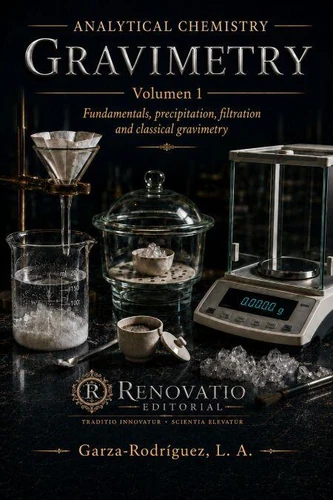
Analytical Chemistry: Gravimetry, Volume 1. Volumen 1, #1
Par :Formats :
Disponible dans votre compte client Decitre ou Furet du Nord dès validation de votre commande. Le format ePub est :
- Compatible avec une lecture sur My Vivlio (smartphone, tablette, ordinateur)
- Compatible avec une lecture sur liseuses Vivlio
- Pour les liseuses autres que Vivlio, vous devez utiliser le logiciel Adobe Digital Edition. Non compatible avec la lecture sur les liseuses Kindle, Remarkable et Sony
 , qui est-ce ?
Notre partenaire de plateforme de lecture numérique où vous retrouverez l'ensemble de vos ebooks gratuitement
Pour en savoir plus sur nos ebooks, consultez notre aide en ligne ici
C'est si simple ! Lisez votre ebook avec l'app Vivlio sur votre tablette, mobile ou ordinateur :

- FormatePub
- ISBN8235400825
- EAN9798235400825
- Date de parution25/06/2026
- Protection num.pas de protection
- Infos supplémentairesepub
- ÉditeurIoakim Ioakim
Résumé
Analytical Chemistry: Gravimetry, Volume 1 is a university-level textbook for readers who need to understand classical gravimetric analysis from its chemical foundations to its laboratory execution. Written in English and organized for digital study, this book presents gravimetry as a complete analytical chain: the sample is selected, the analyte is defined, the matrix is evaluated, the reaction is controlled, the solid is separated and treated, and the final mass is converted into a defensible quantitative result.
This volume is not a simple collection of laboratory procedures. It explains why each operation matters, how chemical equilibria affect the result, and how experimental discipline protects accuracy. The reader is guided through precipitation, filtration, washing, drying, ignition, weighing, calculation, uncertainty, and interpretation with emphasis on reasoning, traceability, and error prevention.
WHAT THIS BOOK COVERS Gravimetry as quantitative chemical measurement. Sample, analyte, matrix, selectivity, and analytical result. Mass, mole, stoichiometry, and gravimetric factors. Solubility, solubility product, and precipitation equilibria. pH control, complexation, and reagent selection. Supersaturation, nucleation, crystal growth, and precipitate formation. Precipitate purity: coprecipitation, adsorption, occlusion, inclusion, and postprecipitation.
Quantitative transfer, washing, filtration, drying, calcination, ignition, and constant mass. Analytical balance operation, good weighing practice, and mass traceability. The book also includes answer sections, appendices, notation and unit conventions, reference atomic masses, molar masses of common gravimetric compounds, recalculated gravimetric factors, solubility products and pKsp values, solubility rules, precipitating reagents, treated and weighing forms, error prevention, significant figures, rounding, and basic uncertainty applied to gravimetric work.
Readers will find conceptual explanations, technical tables, figures, worked examples, practice problems, a glossary, bibliography, and a linked analytical index. Its structure supports university courses, laboratory training, independent review, and professional reference. This book is useful for undergraduate students in analytical chemistry, chemistry, chemical engineering, environmental engineering, and related laboratory sciences.
It also serves instructors who need a structured teaching resource and laboratory professionals who want to reinforce the classical foundations behind reliable quantitative analysis. Garza-Rodríguez, L. A. is an environmental chemical engineer and chemist whose work integrates university teaching, applied research, industrial consulting, and technological development. His academic background includes Environmental Chemical Engineering, graduate specialization in Inorganic Chemistry, and doctoral work in Renewable Energies and Optimization.
His experience spans analytical chemistry, inorganic chemistry, environmental engineering, water treatment, remediation, metal recovery, materials, bioenergy, nanotechnology, and physicochemical processes. He has taught undergraduate and graduate courses in analytical, inorganic, organic, environmental, industrial, and physicochemical areas of chemistry and engineering. His professional work includes wastewater treatment, advanced oxidation, metal recovery, remediation, reagent optimization, separation technologies, and industrial processes with an environmental focus.
This volume reflects that combined background: rigorous chemical theory, practical laboratory judgment, and concern for how analytical results are produced, verified, and reported. It is intended for readers who want to understand the calculations, sources of error, and technical reasoning that make gravimetric analysis reliable.
This volume is not a simple collection of laboratory procedures. It explains why each operation matters, how chemical equilibria affect the result, and how experimental discipline protects accuracy. The reader is guided through precipitation, filtration, washing, drying, ignition, weighing, calculation, uncertainty, and interpretation with emphasis on reasoning, traceability, and error prevention.
WHAT THIS BOOK COVERS Gravimetry as quantitative chemical measurement. Sample, analyte, matrix, selectivity, and analytical result. Mass, mole, stoichiometry, and gravimetric factors. Solubility, solubility product, and precipitation equilibria. pH control, complexation, and reagent selection. Supersaturation, nucleation, crystal growth, and precipitate formation. Precipitate purity: coprecipitation, adsorption, occlusion, inclusion, and postprecipitation.
Quantitative transfer, washing, filtration, drying, calcination, ignition, and constant mass. Analytical balance operation, good weighing practice, and mass traceability. The book also includes answer sections, appendices, notation and unit conventions, reference atomic masses, molar masses of common gravimetric compounds, recalculated gravimetric factors, solubility products and pKsp values, solubility rules, precipitating reagents, treated and weighing forms, error prevention, significant figures, rounding, and basic uncertainty applied to gravimetric work.
Readers will find conceptual explanations, technical tables, figures, worked examples, practice problems, a glossary, bibliography, and a linked analytical index. Its structure supports university courses, laboratory training, independent review, and professional reference. This book is useful for undergraduate students in analytical chemistry, chemistry, chemical engineering, environmental engineering, and related laboratory sciences.
It also serves instructors who need a structured teaching resource and laboratory professionals who want to reinforce the classical foundations behind reliable quantitative analysis. Garza-Rodríguez, L. A. is an environmental chemical engineer and chemist whose work integrates university teaching, applied research, industrial consulting, and technological development. His academic background includes Environmental Chemical Engineering, graduate specialization in Inorganic Chemistry, and doctoral work in Renewable Energies and Optimization.
His experience spans analytical chemistry, inorganic chemistry, environmental engineering, water treatment, remediation, metal recovery, materials, bioenergy, nanotechnology, and physicochemical processes. He has taught undergraduate and graduate courses in analytical, inorganic, organic, environmental, industrial, and physicochemical areas of chemistry and engineering. His professional work includes wastewater treatment, advanced oxidation, metal recovery, remediation, reagent optimization, separation technologies, and industrial processes with an environmental focus.
This volume reflects that combined background: rigorous chemical theory, practical laboratory judgment, and concern for how analytical results are produced, verified, and reported. It is intended for readers who want to understand the calculations, sources of error, and technical reasoning that make gravimetric analysis reliable.