
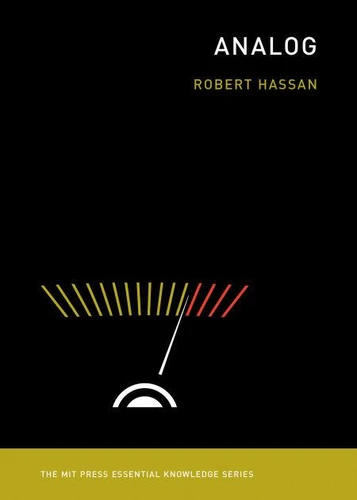
Analog
Par :Formats :
Disponible dans votre compte client Decitre ou Furet du Nord dès validation de votre commande. Le format ePub protégé est :
- Compatible avec une lecture sur My Vivlio (smartphone, tablette, ordinateur)
- Compatible avec une lecture sur liseuses Vivlio
- Pour les liseuses autres que Vivlio, vous devez utiliser le logiciel Adobe Digital Edition. Non compatible avec la lecture sur les liseuses Kindle, Remarkable et Sony
- Non compatible avec un achat hors France métropolitaine
 , qui est-ce ?
Notre partenaire de plateforme de lecture numérique où vous retrouverez l'ensemble de vos ebooks gratuitement
Pour en savoir plus sur nos ebooks, consultez notre aide en ligne ici
C'est si simple ! Lisez votre ebook avec l'app Vivlio sur votre tablette, mobile ou ordinateur :

- Nombre de pages272
- FormatePub
- ISBN978-0-262-37182-7
- EAN9780262371827
- Date de parution03/01/2023
- Protection num.Adobe DRM
- Taille1 Mo
- Infos supplémentairesepub
- ÉditeurThe MIT Press
Résumé
Why, surrounded by screens and smart devices, we feel a deep connection to the analog-vinyl records, fountain pens, Kodak film, and other nondigital tools. We're surrounded by screens; our music comes in the form of digital files; we tap words into a notes app. Why do we still crave the "realness" of analog, seeking out vinyl records, fountain pens, cameras with film? In this volume in the MIT Press Essential Knowledge series, Robert Hassan explores our deep connection to analog technology.
Our analog urge, he explains, is about what we've lost from our technological past, something that's not there in our digital present. We're nostalgic for what we remember indistinctly as somehow more real, more human. Surveying some of the major developments of analog technology, Hassan shows us what's been lost with the digital. Along the way, he discusses the appeal of the 2011 silent, black-and-white Oscar-winning film The Artist; the revival of the non-e-book book; the early mechanical clocks that enforced prayer and worship times; and the programmable loom.
He describes the effect of the typewriter on Nietzsche's productivity, the pivotal invention of the telegraph, and the popularity of the first televisions despite their iffy picture quality. The transition to digital is marked by the downgrading of human participation in the human-technology relationship. We have unwittingly unmoored ourselves, Hassan warns, from the anchors of analog technology and the natural world.
Our analog nostalgia is for those ancient aspects of who and what we are.
Our analog urge, he explains, is about what we've lost from our technological past, something that's not there in our digital present. We're nostalgic for what we remember indistinctly as somehow more real, more human. Surveying some of the major developments of analog technology, Hassan shows us what's been lost with the digital. Along the way, he discusses the appeal of the 2011 silent, black-and-white Oscar-winning film The Artist; the revival of the non-e-book book; the early mechanical clocks that enforced prayer and worship times; and the programmable loom.
He describes the effect of the typewriter on Nietzsche's productivity, the pivotal invention of the telegraph, and the popularity of the first televisions despite their iffy picture quality. The transition to digital is marked by the downgrading of human participation in the human-technology relationship. We have unwittingly unmoored ourselves, Hassan warns, from the anchors of analog technology and the natural world.
Our analog nostalgia is for those ancient aspects of who and what we are.