SOLDES
Jusqu'à -70% sur une sélection d'articles*

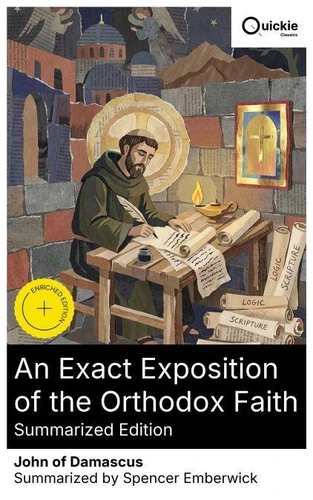
An Exact Exposition of the Orthodox Faith (Summarized Edition). Enriched edition. An 8th-Century Systematic Theology of the Early Church: Trinitarian and Christological Debates
Par : , ,Formats :
Disponible dans votre compte client Decitre ou Furet du Nord dès validation de votre commande. Le format ePub est :
- Compatible avec une lecture sur My Vivlio (smartphone, tablette, ordinateur)
- Compatible avec une lecture sur liseuses Vivlio
- Pour les liseuses autres que Vivlio, vous devez utiliser le logiciel Adobe Digital Edition. Non compatible avec la lecture sur les liseuses Kindle, Remarkable et Sony
 , qui est-ce ?
Notre partenaire de plateforme de lecture numérique où vous retrouverez l'ensemble de vos ebooks gratuitement
Pour en savoir plus sur nos ebooks, consultez notre aide en ligne ici
C'est si simple ! Lisez votre ebook avec l'app Vivlio sur votre tablette, mobile ou ordinateur :

- Nombre de pages130
- FormatePub
- ISBN859-65--4789307-3
- EAN8596547893073
- Date de parution03/04/2026
- Protection num.Digital Watermarking
- Taille943 Ko
- Infos supplémentairesepub
- ÉditeurQUICKIE CLASSICS
Résumé
An Exact Exposition of the Orthodox Faith, the third part of John's Fount of Knowledge, is the earliest systematic summa of Greek patristic doctrine. In crisp chapters it treats God and the Trinity, creation and providence, angels and humanity, the Incarnation with two natures and wills, sacraments, Scripture and tradition, veneration of saints and images, and last things. Drawing Aristotelian distinctions through a catena of Fathers, it consolidates the conciliar settlement amid Iconoclasm.
John of Damascus (c. 675-749) was a Damascene Christian official under the Umayyads who became a monk at Mar Saba near Jerusalem. Trained in logic (the Dialectica) and steeped in liturgy and hymnody, he wrote to safeguard orthodox teaching after the councils and to answer Christological errors and the iconoclast controversy. Students of patristics, historical theology, and philosophy will find here a lucid map of early Christian dogma, faithful to sources yet remarkably concise.
Read it with the conciliar definitions it distills, and let its measured arguments guide catechesis, ecumenical conversation, and contemplative practice within the living tradition of the Church. Quickie Classics summarizes timeless works with precision, preserving the author's voice and keeping the prose clear, fast, and readable-distilled, never diluted. Enriched Edition extras: Introduction · Synopsis · Historical Context · Brief Analysis · 4 Reflection Q&As · Editorial Footnotes.
John of Damascus (c. 675-749) was a Damascene Christian official under the Umayyads who became a monk at Mar Saba near Jerusalem. Trained in logic (the Dialectica) and steeped in liturgy and hymnody, he wrote to safeguard orthodox teaching after the councils and to answer Christological errors and the iconoclast controversy. Students of patristics, historical theology, and philosophy will find here a lucid map of early Christian dogma, faithful to sources yet remarkably concise.
Read it with the conciliar definitions it distills, and let its measured arguments guide catechesis, ecumenical conversation, and contemplative practice within the living tradition of the Church. Quickie Classics summarizes timeless works with precision, preserving the author's voice and keeping the prose clear, fast, and readable-distilled, never diluted. Enriched Edition extras: Introduction · Synopsis · Historical Context · Brief Analysis · 4 Reflection Q&As · Editorial Footnotes.