
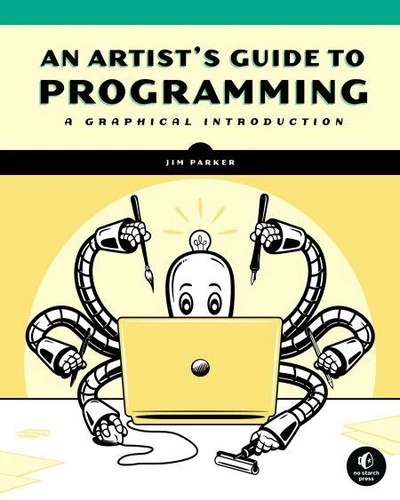
An Artist's Guide to Programming. A Graphical Introduction
Par :Formats :
Disponible dans votre compte client Decitre ou Furet du Nord dès validation de votre commande. Le format ePub est :
- Compatible avec une lecture sur My Vivlio (smartphone, tablette, ordinateur)
- Compatible avec une lecture sur liseuses Vivlio
- Pour les liseuses autres que Vivlio, vous devez utiliser le logiciel Adobe Digital Edition. Non compatible avec la lecture sur les liseuses Kindle, Remarkable et Sony
 , qui est-ce ?
Notre partenaire de plateforme de lecture numérique où vous retrouverez l'ensemble de vos ebooks gratuitement
Pour en savoir plus sur nos ebooks, consultez notre aide en ligne ici
C'est si simple ! Lisez votre ebook avec l'app Vivlio sur votre tablette, mobile ou ordinateur :

- Nombre de pages248
- FormatePub
- ISBN978-1-7185-0165-2
- EAN9781718501652
- Date de parution07/06/2022
- Protection num.pas de protection
- Taille9 Mo
- Infos supplémentairesepub
- ÉditeurNo Starch Press
Résumé
Learn to program with visual examples. Programs increase in complexity as you progress - from drawing a circle to 3D graphics, animations, and simulations. A Graphical Introduction to Programming teaches computer programming with the aid of 100 example programs, each of which integrates graphical or sound output. The Processing-language-based examples range from drawing a circle and animating bouncing balls to 3D graphics, audio visualization, and interactive games. Readers learn core programming concepts like conditions, loops, arrays, strings and functions, as well as how to use Processing to draw lines, shapes, and 3D objects.
They'll learn key computer graphics concepts like manipulating images, animating text, mapping textures onto objects, and working with video. Advanced examples include sound effects and audio visualization, network communication, 3D geometry and animation, simulations of snow and smoke, predator-prey populations, and interactive games.
They'll learn key computer graphics concepts like manipulating images, animating text, mapping textures onto objects, and working with video. Advanced examples include sound effects and audio visualization, network communication, 3D geometry and animation, simulations of snow and smoke, predator-prey populations, and interactive games.