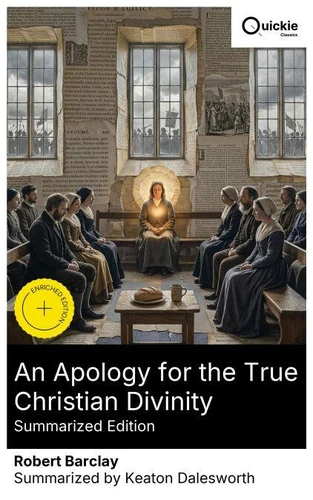
An Apology for the True Christian Divinity (Summarized Edition). Enriched edition. Quaker theology and the Inner Light in 17th-century Scotland: a rational defense of faith and simplicity in worship
Par : , ,Formats :
Disponible dans votre compte client Decitre ou Furet du Nord dès validation de votre commande. Le format ePub est :
- Compatible avec une lecture sur My Vivlio (smartphone, tablette, ordinateur)
- Compatible avec une lecture sur liseuses Vivlio
- Pour les liseuses autres que Vivlio, vous devez utiliser le logiciel Adobe Digital Edition. Non compatible avec la lecture sur les liseuses Kindle, Remarkable et Sony
 , qui est-ce ?
Notre partenaire de plateforme de lecture numérique où vous retrouverez l'ensemble de vos ebooks gratuitement
Pour en savoir plus sur nos ebooks, consultez notre aide en ligne ici
C'est si simple ! Lisez votre ebook avec l'app Vivlio sur votre tablette, mobile ou ordinateur :

- Nombre de pages185
- FormatePub
- ISBN859-65--4789285-4
- EAN8596547892854
- Date de parution03/04/2026
- Protection num.Digital Watermarking
- Taille978 Ko
- Infos supplémentairesepub
- ÉditeurQUICKIE CLASSICS
Résumé
An Apology for the True Christian Divinity is Robert Barclay's systematic defense of the Religious Society of Friends. In tightly argued propositions supported by Scripture, reason, and early Christian testimony, it expounds the inward Light of Christ, the primacy of immediate revelation, and the inwardness of baptism and the Supper. It clarifies Quaker worship, ministry, and testimonies while answering standard objections.
Composed amid seventeenth-century strife and dedicated to Charles II, its scholastic clarity serves a pastoral, reforming aim. Barclay, a Scotsman of Ury educated at the Scots College, Paris, embraced Quakerism young and brought classical training to the task. Fluent in Latin, he issued the work first in that language in 1676 and soon in English in 1678. Imprisonments for conscience-especially at Aberdeen-and friendship with William Penn sharpened his appeal to magistrates and divines, furthered by his father's late-life conversion.
Students of early modern theology and church history will find a lucid gateway to Quaker divinity. Whether seeking a classic on Scripture and Spirit, a case study in toleration, or an exemplar of irenic polemic, readers will be rewarded. It remains indispensable for understanding conscience, worship, and discipline in the most durable stream of the Radical Reformation. Quickie Classics summarizes timeless works with precision, preserving the author's voice and keeping the prose clear, fast, and readable-distilled, never diluted.
Enriched Edition extras: Introduction · Synopsis · Historical Context · Brief Analysis · 4 Reflection Q&As · Editorial Footnotes.
Composed amid seventeenth-century strife and dedicated to Charles II, its scholastic clarity serves a pastoral, reforming aim. Barclay, a Scotsman of Ury educated at the Scots College, Paris, embraced Quakerism young and brought classical training to the task. Fluent in Latin, he issued the work first in that language in 1676 and soon in English in 1678. Imprisonments for conscience-especially at Aberdeen-and friendship with William Penn sharpened his appeal to magistrates and divines, furthered by his father's late-life conversion.
Students of early modern theology and church history will find a lucid gateway to Quaker divinity. Whether seeking a classic on Scripture and Spirit, a case study in toleration, or an exemplar of irenic polemic, readers will be rewarded. It remains indispensable for understanding conscience, worship, and discipline in the most durable stream of the Radical Reformation. Quickie Classics summarizes timeless works with precision, preserving the author's voice and keeping the prose clear, fast, and readable-distilled, never diluted.
Enriched Edition extras: Introduction · Synopsis · Historical Context · Brief Analysis · 4 Reflection Q&As · Editorial Footnotes.