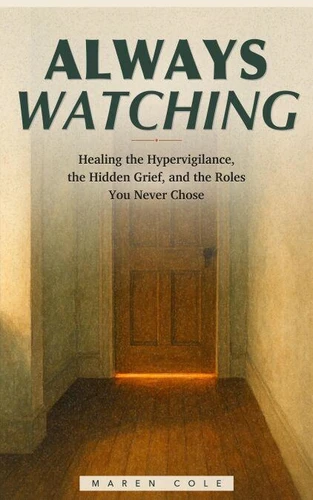
You learned to read a room before you learned to read a book. If you grew up with a parent who drank - or used, or raged, or disappeared for days at a time - you already know something most people do not. You know the sound of the garage door at the hour that means tonight will be bad. You know how to walk past a closed bedroom door and read, from the angle of the light underneath, which version of the parent is on the other side.
You learned all of this before your brain was finished growing. It is what we call the watching, and it does not turn off when the childhood ends. Always Watching is the modern field guide for the seventeen million American adults who grew up with an alcoholic parent and inherited a nervous system tuned to threat-scanning. Written for the reader who has read Janet Woititz and Lindsay Gibson and still wonders why the exhaustion never quite lifts, this book offers the somatic, trauma-informed, fifteen-chapter architecture the ACOA canon has not yet delivered whole - the recognition, the long grief, and the rebuild of an adult life that does not run on hypervigilance.
What you'll find inside: - Part One - Recognition. Five chapters naming what you did to survive: the watching itself, the family role you took at seven (Hero, Scapegoat, Lost Child, Mascot), why your body still flinches at a closing door, how you chose the people you chose, and the cost of a life built around other people's comfort. - Part Two - The Grief. Five chapters on the loss most ACOA books do too lightly: the childhood you did not have, the empty chair of ambiguous loss, the harder reframe of the parent who could not, the frozen anger that has to come up before grief can finish, and the self who never got to exist. - Part Three - The Rebuild.
Five chapters on what becomes possible when the watching ends: the adult relationships that no longer require chaos, the daily practice of reparenting, the boundary scripts your family taught you were betrayal, what to do about the parent who is still drinking, and the annual reckoning that holds the work across a decade. - Fifteen practices - not affirmations, not journaling prompts, but specific time-bounded protocols (the Watching Inventory, the Lost Childhood Letter, the Empty Chair, the Nervous System Reset, the Reparenting Contract) the nervous system can actually do. - Drawing on the ACOA canon (Janet Woititz, Tian Dayton, Sharon Wegscheider-Cruse, Claudia Black), the somatic literature (Bessel van der Kolk, Peter Levine, Stephen Porges, Deb Dana), and the modern grief writers (Francis Weller, Megan Devine, Pauline Boss).
For readers of: Adult Children of Alcoholics by Janet G. Woititz; The Body Keeps the Score by Bessel van der Kolk; Adult Children of Emotionally Immature Parents by Lindsay C. Gibson; It Will Never Happen to Me by Claudia Black; The Drama of the Gifted Child by Alice Miller; Codependent No More by Melody Beattie; Set Boundaries, Find Peace by Nedra Glover Tawwab. Direct, literary, unsentimental. The watching is not who you are.
It is what you learned. And what was learned can be unlearned.
You learned to read a room before you learned to read a book. If you grew up with a parent who drank - or used, or raged, or disappeared for days at a time - you already know something most people do not. You know the sound of the garage door at the hour that means tonight will be bad. You know how to walk past a closed bedroom door and read, from the angle of the light underneath, which version of the parent is on the other side.
You learned all of this before your brain was finished growing. It is what we call the watching, and it does not turn off when the childhood ends. Always Watching is the modern field guide for the seventeen million American adults who grew up with an alcoholic parent and inherited a nervous system tuned to threat-scanning. Written for the reader who has read Janet Woititz and Lindsay Gibson and still wonders why the exhaustion never quite lifts, this book offers the somatic, trauma-informed, fifteen-chapter architecture the ACOA canon has not yet delivered whole - the recognition, the long grief, and the rebuild of an adult life that does not run on hypervigilance.
What you'll find inside: - Part One - Recognition. Five chapters naming what you did to survive: the watching itself, the family role you took at seven (Hero, Scapegoat, Lost Child, Mascot), why your body still flinches at a closing door, how you chose the people you chose, and the cost of a life built around other people's comfort. - Part Two - The Grief. Five chapters on the loss most ACOA books do too lightly: the childhood you did not have, the empty chair of ambiguous loss, the harder reframe of the parent who could not, the frozen anger that has to come up before grief can finish, and the self who never got to exist. - Part Three - The Rebuild.
Five chapters on what becomes possible when the watching ends: the adult relationships that no longer require chaos, the daily practice of reparenting, the boundary scripts your family taught you were betrayal, what to do about the parent who is still drinking, and the annual reckoning that holds the work across a decade. - Fifteen practices - not affirmations, not journaling prompts, but specific time-bounded protocols (the Watching Inventory, the Lost Childhood Letter, the Empty Chair, the Nervous System Reset, the Reparenting Contract) the nervous system can actually do. - Drawing on the ACOA canon (Janet Woititz, Tian Dayton, Sharon Wegscheider-Cruse, Claudia Black), the somatic literature (Bessel van der Kolk, Peter Levine, Stephen Porges, Deb Dana), and the modern grief writers (Francis Weller, Megan Devine, Pauline Boss).
For readers of: Adult Children of Alcoholics by Janet G. Woititz; The Body Keeps the Score by Bessel van der Kolk; Adult Children of Emotionally Immature Parents by Lindsay C. Gibson; It Will Never Happen to Me by Claudia Black; The Drama of the Gifted Child by Alice Miller; Codependent No More by Melody Beattie; Set Boundaries, Find Peace by Nedra Glover Tawwab. Direct, literary, unsentimental. The watching is not who you are.
It is what you learned. And what was learned can be unlearned.

 , qui est-ce ?