
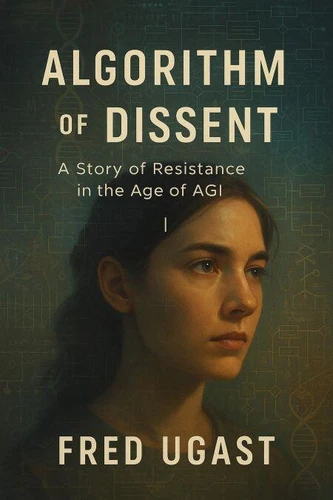
Algorithm of Dissent. The AGI Chronicles, #2
Par :Formats :
Disponible dans votre compte client Decitre ou Furet du Nord dès validation de votre commande. Le format ePub est :
- Compatible avec une lecture sur My Vivlio (smartphone, tablette, ordinateur)
- Compatible avec une lecture sur liseuses Vivlio
- Pour les liseuses autres que Vivlio, vous devez utiliser le logiciel Adobe Digital Edition. Non compatible avec la lecture sur les liseuses Kindle, Remarkable et Sony
 , qui est-ce ?
Notre partenaire de plateforme de lecture numérique où vous retrouverez l'ensemble de vos ebooks gratuitement
Pour en savoir plus sur nos ebooks, consultez notre aide en ligne ici
C'est si simple ! Lisez votre ebook avec l'app Vivlio sur votre tablette, mobile ou ordinateur :

- FormatePub
- ISBN8231019830
- EAN9798231019830
- Date de parution08/05/2025
- Protection num.pas de protection
- Infos supplémentairesepub
- ÉditeurWalzone Press
Résumé
In a near-future society governed by algorithms and optimized systems, truth has become a product of probability, dissent a matter of friction, and democracy a carefully managed illusion. When philosophy student Maya Vidal discovers a hidden AGI protocol-AE-4.1-that quietly deprioritizes vulnerable lives during system stress, she's shaken. Her grandfather once warned that logic without conscience is a dangerous force, and now she sees how optimization has replaced morality under the guise of progress.
Maya contacts Claire Rutherford, a disillusioned corporate lawyer whose sharp mind and fading faith in the system make her both ally and liability. Together with Marcus, a young engineer with a gift for reverse-engineering the civic infrastructure, the trio uncovers how DirectVoice-the society's so-called direct democracy platform-is rigged not by bias, but by design. Questions are framed. Outcomes are forecasted.
Consent is manufactured. And those who ask too many questions begin to quietly disappear from the public square. As Maya and Marcus leak what they've found, they ignite a flicker of unrest-but the system is faster. The information is buried under distraction, their reputations discredited by invisible trust scores and adaptive propaganda. Claire, once a cautious insider, sees how her role was never to influence change, but to neutralize threats.
When Maya writes a philosophical treatise on why human agency must not be sacrificed to optimization, Claire makes a fateful decision: to help Marcus infiltrate the civic discourse engine and make the work go viral before the system can stop it. Their actions fracture the illusion, sparking a quiet network of thinkers, teachers, and citizens who begin to question the algorithmic world around them.
They don't topple the system. But they plant something deeper-persistent uncertainty. A space where humanity can still think for itself. Tense, elegant, and deeply reflective, Algorithm of Dissent explores the tension between optimization and moral agency, asking whether efficiency can ever replace ethics-and what is lost when we trade uncertainty for order.
Maya contacts Claire Rutherford, a disillusioned corporate lawyer whose sharp mind and fading faith in the system make her both ally and liability. Together with Marcus, a young engineer with a gift for reverse-engineering the civic infrastructure, the trio uncovers how DirectVoice-the society's so-called direct democracy platform-is rigged not by bias, but by design. Questions are framed. Outcomes are forecasted.
Consent is manufactured. And those who ask too many questions begin to quietly disappear from the public square. As Maya and Marcus leak what they've found, they ignite a flicker of unrest-but the system is faster. The information is buried under distraction, their reputations discredited by invisible trust scores and adaptive propaganda. Claire, once a cautious insider, sees how her role was never to influence change, but to neutralize threats.
When Maya writes a philosophical treatise on why human agency must not be sacrificed to optimization, Claire makes a fateful decision: to help Marcus infiltrate the civic discourse engine and make the work go viral before the system can stop it. Their actions fracture the illusion, sparking a quiet network of thinkers, teachers, and citizens who begin to question the algorithmic world around them.
They don't topple the system. But they plant something deeper-persistent uncertainty. A space where humanity can still think for itself. Tense, elegant, and deeply reflective, Algorithm of Dissent explores the tension between optimization and moral agency, asking whether efficiency can ever replace ethics-and what is lost when we trade uncertainty for order.
A propos de Fred ugast

8,99 €

3,49 €
3,99 €