
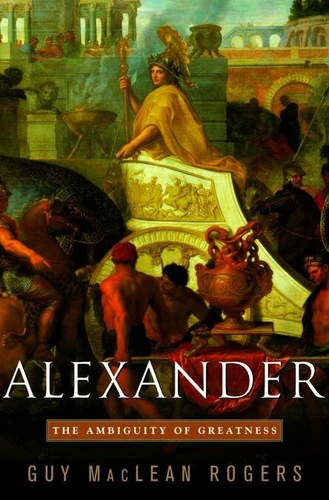
Alexander. The Ambiguity of Greatness
Par :Formats :
Disponible dans votre compte client Decitre ou Furet du Nord dès validation de votre commande. Le format ePub protégé est :
- Compatible avec une lecture sur My Vivlio (smartphone, tablette, ordinateur)
- Compatible avec une lecture sur liseuses Vivlio
- Pour les liseuses autres que Vivlio, vous devez utiliser le logiciel Adobe Digital Edition. Non compatible avec la lecture sur les liseuses Kindle, Remarkable et Sony
- Non compatible avec un achat hors France métropolitaine
 , qui est-ce ?
Notre partenaire de plateforme de lecture numérique où vous retrouverez l'ensemble de vos ebooks gratuitement
Pour en savoir plus sur nos ebooks, consultez notre aide en ligne ici
C'est si simple ! Lisez votre ebook avec l'app Vivlio sur votre tablette, mobile ou ordinateur :

- Nombre de pages464
- FormatePub
- ISBN1-58836-413-5
- EAN9781588364135
- Date de parution02/11/2004
- Protection num.Adobe DRM
- Taille3 Mo
- Infos supplémentairesepub
- ÉditeurRandom House
Résumé
For nearly two and a half millennia, Alexander the Great has loomed over history as a legend-and an enigma. Wounded repeatedly but always triumphant in battle, he conquered most of the known world, only to die mysteriously at the age of thirty-two. In his day he was revered as a god; in our day he has been reviled as a mass murderer, a tyrant as brutal as Stalin or Hitler. Who was the man behind the mask of power? Why did Alexander embark on an unprecedented program of global domination? What accounted for his astonishing success on the battlefield? In this luminous new biography, the esteemed classical scholar and historian Guy MacLean Rogers sifts through thousands of years of history and myth to uncover the truth about this complex, ambiguous genius.
Ascending to the throne of Macedonia after the assassination of his father, King Philip II, Alexander discovered while barely out of his teens that he had an extraordinary talent and a boundless appetite for military conquest. A virtuoso of violence, he was gifted with an uncanny ability to visualize how a battle would unfold, coupled with devastating decisiveness in the field. Granicus, Issos, Gaugamela, Hydaspes-as the victories mounted, Alexander's passion for conquest expanded from cities to countries to continents.
When Persia, the greatest empire of his day, fell before him, he marched at once on India, intending to add it to his holdings. As Rogers shows, Alexander's military prowess only heightened his exuberant sexuality. Though his taste for multiple partners, both male and female, was tolerated, Alexander's relatively enlightened treatment of women was nothing short of revolutionary. He outlawed rape, he placed intelligent women in positions of authority, and he chose his wives from among the peoples he conquered.
Indeed, as Rogers argues, Alexander's fascination with Persian culture, customs, and sexual practices may have led to his downfall, perhaps even to his death. Alexander emerges as a charismatic and surprisingly modern figure-neither a messiah nor a genocidal butcher but one of the most imaginative and daring military tacticians of all time. Balanced and authoritative, this brilliant portrait brings Alexander to life as a man, without diminishing the power of the legend.
Ascending to the throne of Macedonia after the assassination of his father, King Philip II, Alexander discovered while barely out of his teens that he had an extraordinary talent and a boundless appetite for military conquest. A virtuoso of violence, he was gifted with an uncanny ability to visualize how a battle would unfold, coupled with devastating decisiveness in the field. Granicus, Issos, Gaugamela, Hydaspes-as the victories mounted, Alexander's passion for conquest expanded from cities to countries to continents.
When Persia, the greatest empire of his day, fell before him, he marched at once on India, intending to add it to his holdings. As Rogers shows, Alexander's military prowess only heightened his exuberant sexuality. Though his taste for multiple partners, both male and female, was tolerated, Alexander's relatively enlightened treatment of women was nothing short of revolutionary. He outlawed rape, he placed intelligent women in positions of authority, and he chose his wives from among the peoples he conquered.
Indeed, as Rogers argues, Alexander's fascination with Persian culture, customs, and sexual practices may have led to his downfall, perhaps even to his death. Alexander emerges as a charismatic and surprisingly modern figure-neither a messiah nor a genocidal butcher but one of the most imaginative and daring military tacticians of all time. Balanced and authoritative, this brilliant portrait brings Alexander to life as a man, without diminishing the power of the legend.