
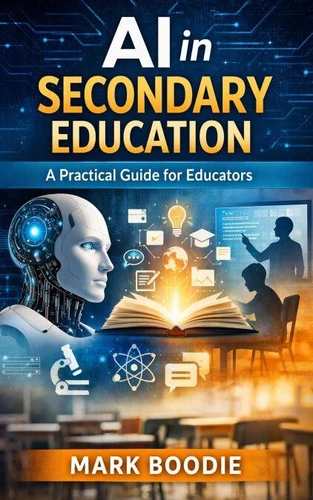
AI in Secondary Education A Practical Guide for Educators
Par :Formats :
Disponible dans votre compte client Decitre ou Furet du Nord dès validation de votre commande. Le format ePub est :
- Compatible avec une lecture sur My Vivlio (smartphone, tablette, ordinateur)
- Compatible avec une lecture sur liseuses Vivlio
- Pour les liseuses autres que Vivlio, vous devez utiliser le logiciel Adobe Digital Edition. Non compatible avec la lecture sur les liseuses Kindle, Remarkable et Sony
 , qui est-ce ?
Notre partenaire de plateforme de lecture numérique où vous retrouverez l'ensemble de vos ebooks gratuitement
Pour en savoir plus sur nos ebooks, consultez notre aide en ligne ici
C'est si simple ! Lisez votre ebook avec l'app Vivlio sur votre tablette, mobile ou ordinateur :

- FormatePub
- ISBN8233126215
- EAN9798233126215
- Date de parution07/02/2026
- Protection num.pas de protection
- Infos supplémentairesepub
- ÉditeurLinda Balsamo
Résumé
Artificial intelligence is already shaping secondary classrooms-but many teachers are still unsure how to use it responsibly, effectively, and without losing pedagogical control. AI in Secondary Education: A Practical Guide for Educators provides a clear, research-informed roadmap for teachers who want to integrate AI into their practice without hype, fear, or technical complexity. Rather than treating AI as a shortcut or a threat, this book positions it as a precision teaching assistant-one that only works well when guided by professional judgment.
You'll learn how large language models actually function, why they sometimes produce confident but inaccurate information, and how teachers can design prompts that respect grade level, curriculum goals, and student development. Grounded in classroom realities, this guide introduces the P. C. R. Framework (Purpose, Context, Requirements), a practical approach that allows teachers to: Generate lesson plans, feedback, and differentiated materials efficiently Design assessments that work with AI rather than against it Support student writing without encouraging dependency or plagiarism Teach students to verify, question, and critique AI outputs Address bias, privacy, and ethical boundaries in real classroom scenarios Across subjects-including English, Science, History, Mathematics, and Language learning-the book shows how AI can reduce teacher workload without replacing professional expertise.
Special attention is given to adolescent cognitive development, information literacy, and equity, ensuring AI use supports learning rather than distorting it. This is not a technical manual and not a collection of gimmicks. It is a professional guide for secondary educators who want to remain firmly in control of instruction in an AI-rich world. If you want to save time, protect learning integrity, and prepare students to think critically about AI-not just use it-this book is for you.
You'll learn how large language models actually function, why they sometimes produce confident but inaccurate information, and how teachers can design prompts that respect grade level, curriculum goals, and student development. Grounded in classroom realities, this guide introduces the P. C. R. Framework (Purpose, Context, Requirements), a practical approach that allows teachers to: Generate lesson plans, feedback, and differentiated materials efficiently Design assessments that work with AI rather than against it Support student writing without encouraging dependency or plagiarism Teach students to verify, question, and critique AI outputs Address bias, privacy, and ethical boundaries in real classroom scenarios Across subjects-including English, Science, History, Mathematics, and Language learning-the book shows how AI can reduce teacher workload without replacing professional expertise.
Special attention is given to adolescent cognitive development, information literacy, and equity, ensuring AI use supports learning rather than distorting it. This is not a technical manual and not a collection of gimmicks. It is a professional guide for secondary educators who want to remain firmly in control of instruction in an AI-rich world. If you want to save time, protect learning integrity, and prepare students to think critically about AI-not just use it-this book is for you.