
Nouveauté
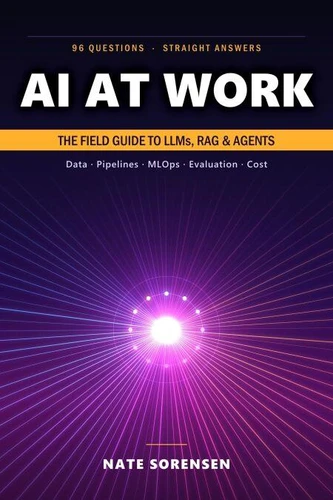
AI at Work
Par :Formats :
Disponible dans votre compte client Decitre ou Furet du Nord dès validation de votre commande. Le format ePub est :
- Compatible avec une lecture sur My Vivlio (smartphone, tablette, ordinateur)
- Compatible avec une lecture sur liseuses Vivlio
- Pour les liseuses autres que Vivlio, vous devez utiliser le logiciel Adobe Digital Edition. Non compatible avec la lecture sur les liseuses Kindle, Remarkable et Sony
 , qui est-ce ?
Notre partenaire de plateforme de lecture numérique où vous retrouverez l'ensemble de vos ebooks gratuitement
Pour en savoir plus sur nos ebooks, consultez notre aide en ligne ici
C'est si simple ! Lisez votre ebook avec l'app Vivlio sur votre tablette, mobile ou ordinateur :

- FormatePub
- ISBN8233694806
- EAN9798233694806
- Date de parution28/07/2026
- Protection num.pas de protection
- Infos supplémentairesepub
- ÉditeurLinda Balsamo
Résumé
Everyone at work now has to make decisions about AI. Very few people have been given a straight explanation of how it actually works. AI at Work is a practical Q&A handbook for anyone who has to build with, decide about, or explain AI systems: engineers, analysts, product and project people, team leads. Ninety-plus questions, each answered on its own terms, each following the same shape - the mechanism, the trade-off, and what to do about it on Monday morning.
No mathematics required. Inside you will find clear answers to the questions that actually come up:- Why do models hallucinate, and what genuinely reduces it?- What is the context window really spent on, and in what priority?- RAG, fine-tuning or prompting - how do you choose?- What separates an agent from a chatbot, and what is MCP for?- When should you deliberately not use an LLM?- How do you evaluate something non-deterministic before you ship it?- What does an AI incident look like, and how do you respond?- Where does the money go, and which levers actually cut cost and latency?Twelve chapters cover foundations, classic ML versus generative AI, RAG and context engineering, tools and agents, data pipelines, MLOps and LLMOps, evaluation, orchestration and cost, automation tooling, the current model and CLI landscape, and security and governance - closing with a twelve-line cheat sheet worth having word-perfect.
Skip to what you need. Every answer stands alone.
No mathematics required. Inside you will find clear answers to the questions that actually come up:- Why do models hallucinate, and what genuinely reduces it?- What is the context window really spent on, and in what priority?- RAG, fine-tuning or prompting - how do you choose?- What separates an agent from a chatbot, and what is MCP for?- When should you deliberately not use an LLM?- How do you evaluate something non-deterministic before you ship it?- What does an AI incident look like, and how do you respond?- Where does the money go, and which levers actually cut cost and latency?Twelve chapters cover foundations, classic ML versus generative AI, RAG and context engineering, tools and agents, data pipelines, MLOps and LLMOps, evaluation, orchestration and cost, automation tooling, the current model and CLI landscape, and security and governance - closing with a twelve-line cheat sheet worth having word-perfect.
Skip to what you need. Every answer stands alone.