After successfully completing a Masters in Social Sciences from the Ecole des Hautes Etudes en Sciences Sociales (School of Advanced Studies in Social Sciences) in Paris, Mahrukh Arif-Tayyeb settled in the UK as a freelance writer. This book is the achievement of two years of fieldwork and research carried out independently in Britain.
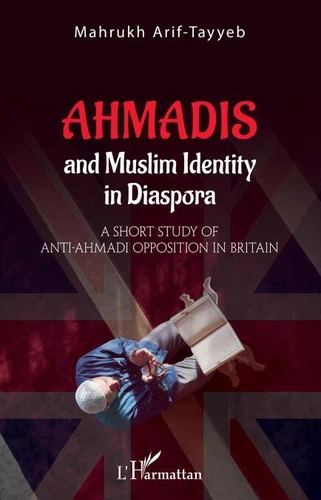
Ahmadis and Muslim Identity in Diaspora. A short study of anti-Ahmadi opposition in britain
Par :Formats :
Disponible dans votre compte client Decitre ou Furet du Nord dès validation de votre commande. Le format ePub est :
- Compatible avec une lecture sur My Vivlio (smartphone, tablette, ordinateur)
- Compatible avec une lecture sur liseuses Vivlio
- Pour les liseuses autres que Vivlio, vous devez utiliser le logiciel Adobe Digital Edition. Non compatible avec la lecture sur les liseuses Kindle, Remarkable et Sony
 , qui est-ce ?
Notre partenaire de plateforme de lecture numérique où vous retrouverez l'ensemble de vos ebooks gratuitement
Pour en savoir plus sur nos ebooks, consultez notre aide en ligne ici
C'est si simple ! Lisez votre ebook avec l'app Vivlio sur votre tablette, mobile ou ordinateur :

- Nombre de pages162
- FormatePub
- ISBN978-2-14-020846-1
- EAN9782140208461
- Date de parution22/03/2022
- Protection num.Digital Watermarking
- Taille4 Mo
- Infos supplémentairesepub
- ÉditeurL'Harmattan
Résumé
In the introduction to his book, Yohannan Friedmann wrote that the Ahmadiyya has been one of the "most active and controversial movements within modern Islam". Indeed, the Muslimness of the Ahmadis has been debated ever since the inception of the movement in the 19th century, where several successive fatwas declared its supporters to be heretics and deviants. In Pakistan, this Muslim minority will be declared non-muslim through a Constitutional amendment and later an Ordinance will go as far as criminalizing their right to be Muslims.
The community will thus face a wave of persecution and violence under the sight of the Pakistani State's silence. In 1984, the community led by a caliphate will find refuge in Britain and will start to explore the freedom to express and display their religious identity in a visible manner. Through the theoretical framework of two sociologists of the School of Chicago - Howard Becker and Erving Goffman - and their work on deviant communities, this book explores to what extent the lack of recognition of the Muslim identity of Ahmadis in Pakistan evolves in the specific diasporic context of Britain. This book examines the relationship between the treatment of a politically controlled minority in a theocracy and the modalities of its importation into a Western democracy.
The community will thus face a wave of persecution and violence under the sight of the Pakistani State's silence. In 1984, the community led by a caliphate will find refuge in Britain and will start to explore the freedom to express and display their religious identity in a visible manner. Through the theoretical framework of two sociologists of the School of Chicago - Howard Becker and Erving Goffman - and their work on deviant communities, this book explores to what extent the lack of recognition of the Muslim identity of Ahmadis in Pakistan evolves in the specific diasporic context of Britain. This book examines the relationship between the treatment of a politically controlled minority in a theocracy and the modalities of its importation into a Western democracy.