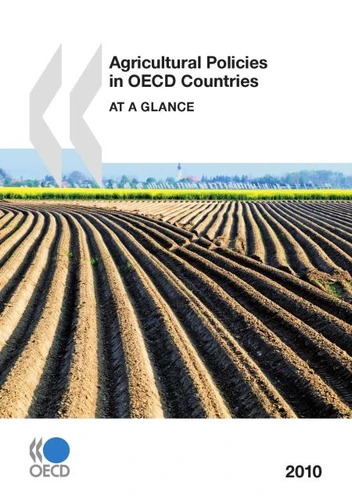
This report is a unique source of up-to date estimates of support to agriculture. It provides an overview of agricultural support in the OECD areas, complemented by individual chapters on the development of support in all OECD countries. Agricultural Policies in OECD Countries: At a Glance is published every other year, alternating with the longer report, Agricultural Policies in OECD Countries: Monitoring and Evaluation.
This book includes StatLinks, URLs under graphs and tables linking Excel® files with the underlyihng data. This 2010 edition finds that in 2009, support to farmers in OECD countries accounted for 22% of the farmers' gross receipts (%PSE). This was slightly up from 21% in 2008, and marks a return to the level shown in 2007. This is the first increase in support levels in five years, after a steady decline that began in 2004.
Higher commodity prices in 2007 and 2008 were behind falls in the measured support for those years, but in 2009 these prices returned to the same level as in 2007. Despite a long-term reduction in both the level of support and the share of the most distorting forms of support, the latter still dominates in the majority of OECD countries. Some countries have taken clear steps towards reducing the level of support and/or implementing more decoupled support, while others have lagged behind.
In some countries, support is becoming increasingly conditional on famers following specified production practices as part of their government's pursuit of broader policy objectives.
This report is a unique source of up-to date estimates of support to agriculture. It provides an overview of agricultural support in the OECD areas, complemented by individual chapters on the development of support in all OECD countries. Agricultural Policies in OECD Countries: At a Glance is published every other year, alternating with the longer report, Agricultural Policies in OECD Countries: Monitoring and Evaluation.
This book includes StatLinks, URLs under graphs and tables linking Excel® files with the underlyihng data. This 2010 edition finds that in 2009, support to farmers in OECD countries accounted for 22% of the farmers' gross receipts (%PSE). This was slightly up from 21% in 2008, and marks a return to the level shown in 2007. This is the first increase in support levels in five years, after a steady decline that began in 2004.
Higher commodity prices in 2007 and 2008 were behind falls in the measured support for those years, but in 2009 these prices returned to the same level as in 2007. Despite a long-term reduction in both the level of support and the share of the most distorting forms of support, the latter still dominates in the majority of OECD countries. Some countries have taken clear steps towards reducing the level of support and/or implementing more decoupled support, while others have lagged behind.
In some countries, support is becoming increasingly conditional on famers following specified production practices as part of their government's pursuit of broader policy objectives.

 , qui est-ce ?