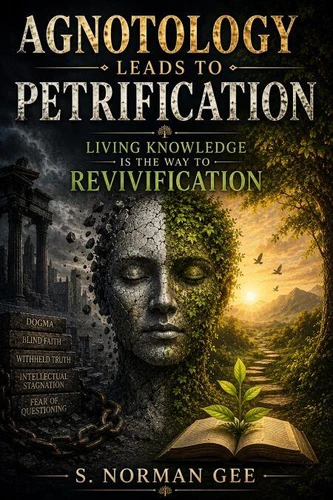
In "Agnotology Leads to Petrification", S. Norman Gee analyzes how modern environments and psychological factors actively construct ignorance, a phenomenon termed "Petrification." The text explores how the human mind shifts from curiosity to rigid certainty, mapping out how comfort and social conformity create limiting, defensive thought patterns. It is presented as a crucial guide for understanding cognitive biases and reclaiming genuine inquiry in an age of systemic echo chambers.
We often treat ignorance as a simple void-a temporary lack of information waiting to be filled with facts. But true ignorance is far more active. It is structured, reinforced, and quietly cultivated inside our knowledge itself. In Agnotology Leads to Petrification, S. Norman Gee delivers a precise philosophical examination of how the modern mind surrenders its vital capacity for deep inquiry. This text maps the invisible transition from fluid curiosity to "Petrification"-the silent, defensive hardening of thought into unyielding certainty.
By analyzing the structures of comfort, habit, and social conformity, this manifesto uncovers the architectural forces that build our mental fortresses. It serves as both a diagnostic mirror for our cognitive blind spots and an urgent guide to breaking through the systemic echo chambers of the modern age. This book was not written to provide answers, but to reopen the questions that time, habit, and certainty have quietly closed.
If these pages do anything, may they remind you that the mind remains alive only as long as it continues to move, to question, to wonder. Truth is not a destination. It is a direction. This book was born from that stillness. Not the stillness of clarity, but the stillness of petrification - the slow, silent hardening of knowledge into certainty, of perception into habit, of understanding into echo.
It is a condition so subtle that most people never notice it happening. They continue to live inside the familiar, unaware that the familiar has become a prison. We imagine ignorance as the absence of knowledge. But ignorance often grows inside knowledge itself. It grows when answers replace questions. When narratives replace encounters. When representations replace reality. When certainty replaces movement.
This book is an exploration of that transformation - the journey from living knowledge to dead certainty, from openness to rigidity, from inquiry to illusion. It is a study of how the mind turns to stone, and how that stone can crack.
In "Agnotology Leads to Petrification", S. Norman Gee analyzes how modern environments and psychological factors actively construct ignorance, a phenomenon termed "Petrification." The text explores how the human mind shifts from curiosity to rigid certainty, mapping out how comfort and social conformity create limiting, defensive thought patterns. It is presented as a crucial guide for understanding cognitive biases and reclaiming genuine inquiry in an age of systemic echo chambers.
We often treat ignorance as a simple void-a temporary lack of information waiting to be filled with facts. But true ignorance is far more active. It is structured, reinforced, and quietly cultivated inside our knowledge itself. In Agnotology Leads to Petrification, S. Norman Gee delivers a precise philosophical examination of how the modern mind surrenders its vital capacity for deep inquiry. This text maps the invisible transition from fluid curiosity to "Petrification"-the silent, defensive hardening of thought into unyielding certainty.
By analyzing the structures of comfort, habit, and social conformity, this manifesto uncovers the architectural forces that build our mental fortresses. It serves as both a diagnostic mirror for our cognitive blind spots and an urgent guide to breaking through the systemic echo chambers of the modern age. This book was not written to provide answers, but to reopen the questions that time, habit, and certainty have quietly closed.
If these pages do anything, may they remind you that the mind remains alive only as long as it continues to move, to question, to wonder. Truth is not a destination. It is a direction. This book was born from that stillness. Not the stillness of clarity, but the stillness of petrification - the slow, silent hardening of knowledge into certainty, of perception into habit, of understanding into echo.
It is a condition so subtle that most people never notice it happening. They continue to live inside the familiar, unaware that the familiar has become a prison. We imagine ignorance as the absence of knowledge. But ignorance often grows inside knowledge itself. It grows when answers replace questions. When narratives replace encounters. When representations replace reality. When certainty replaces movement.
This book is an exploration of that transformation - the journey from living knowledge to dead certainty, from openness to rigidity, from inquiry to illusion. It is a study of how the mind turns to stone, and how that stone can crack.

 , qui est-ce ?


