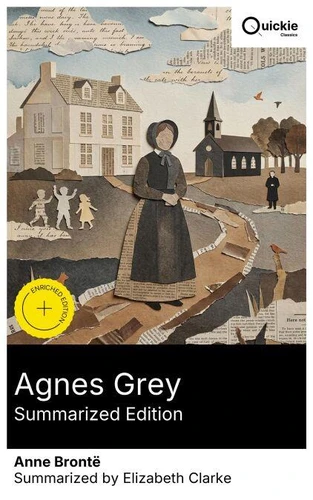
Agnes Grey is a quietly radical governess novel that renders, with austere precision, the daily humiliations and moral trials of a young woman earning her living in middle-class Victorian homes. In lucid first-person prose, it favors close observation over melodrama, exposing how money, manners, and parental indulgence shape children and their keepers. Episodes among the Bloomfields and Murrays accumulate like case studies, anatomized with restrained irony.
Its plain style and ethical seriousness place it between Austen's moral realism and the Brontës' concern for women's autonomy. Anne Brontë (1820-1849), the youngest sister, drew directly on her posts at Blake Hall and with the Robinsons, publishing the novel in 1847 as Acton Bell. Her Anglican conscience, sympathy for animals, and exposure to the precarious economics of women's work inform Agnes's steady, unsentimental voice.
The compression of her poetry and her disenchanted witness to genteel households sharpen the book's critique, prefiguring the more expansive social protest of The Tenant of Wildfell Hall. Readers of Victorian fiction, feminist history, and the ethics of care will value this concise, bracing narrative. For its exact prose, moral clarity, and unsentimental romance with Mr. Weston, Agnes Grey deserves a place beside Jane Eyre.
Quickie Classics summarizes timeless works with precision, preserving the author's voice and keeping the prose clear, fast, and readable-distilled, never diluted.
Enriched Edition extras: Introduction · Synopsis · Historical Context · Author Biography · Brief Analysis · 4 Reflection Q&As · Editorial Footnotes.
Agnes Grey is a quietly radical governess novel that renders, with austere precision, the daily humiliations and moral trials of a young woman earning her living in middle-class Victorian homes. In lucid first-person prose, it favors close observation over melodrama, exposing how money, manners, and parental indulgence shape children and their keepers. Episodes among the Bloomfields and Murrays accumulate like case studies, anatomized with restrained irony.
Its plain style and ethical seriousness place it between Austen's moral realism and the Brontës' concern for women's autonomy. Anne Brontë (1820-1849), the youngest sister, drew directly on her posts at Blake Hall and with the Robinsons, publishing the novel in 1847 as Acton Bell. Her Anglican conscience, sympathy for animals, and exposure to the precarious economics of women's work inform Agnes's steady, unsentimental voice.
The compression of her poetry and her disenchanted witness to genteel households sharpen the book's critique, prefiguring the more expansive social protest of The Tenant of Wildfell Hall. Readers of Victorian fiction, feminist history, and the ethics of care will value this concise, bracing narrative. For its exact prose, moral clarity, and unsentimental romance with Mr. Weston, Agnes Grey deserves a place beside Jane Eyre.
Quickie Classics summarizes timeless works with precision, preserving the author's voice and keeping the prose clear, fast, and readable-distilled, never diluted.
Enriched Edition extras: Introduction · Synopsis · Historical Context · Author Biography · Brief Analysis · 4 Reflection Q&As · Editorial Footnotes.


 , qui est-ce ?