
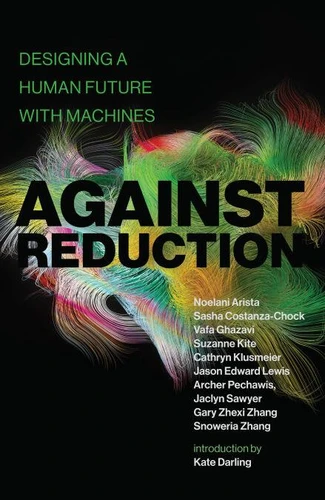
Against Reduction. Designing a Human Future with Machines
Par : , , ,Formats :
Disponible dans votre compte client Decitre ou Furet du Nord dès validation de votre commande. Le format ePub protégé est :
- Compatible avec une lecture sur My Vivlio (smartphone, tablette, ordinateur)
- Compatible avec une lecture sur liseuses Vivlio
- Pour les liseuses autres que Vivlio, vous devez utiliser le logiciel Adobe Digital Edition. Non compatible avec la lecture sur les liseuses Kindle, Remarkable et Sony
- Non compatible avec un achat hors France métropolitaine
 , qui est-ce ?
Notre partenaire de plateforme de lecture numérique où vous retrouverez l'ensemble de vos ebooks gratuitement
Pour en savoir plus sur nos ebooks, consultez notre aide en ligne ici
C'est si simple ! Lisez votre ebook avec l'app Vivlio sur votre tablette, mobile ou ordinateur :

- Nombre de pages128
- FormatePub
- ISBN978-0-262-36732-5
- EAN9780262367325
- Date de parution05/10/2021
- Protection num.Adobe DRM
- Taille27 Mo
- Infos supplémentairesepub
- ÉditeurThe MIT Press
Résumé
Provocative, hopeful essays imagine a future that is not reduced to algorithms. What is human flourishing in an age of machine intelligence, when many claim that the world's most complex problems can be reduced to narrow technical questions? Does more computing make us more intelligent, or simply more computationally powerful? We need not always resist reduction; our ability to simplify helps us interpret complicated situations.
The trick is to know when and how to do so. Against Reduction offers a collection of provocative and illuminating essays that consider different ways of recognizing and addressing the reduction in our approach to artificial intelligence, and ultimately to ourselves. Inspired by a widely read manifesto by Joi Ito that called for embracing the diversity and irreducibility of the world, these essays offer persuasive and compelling variations on resisting reduction.
Among other things, the writers draw on indigenous epistemology to argue for an extended "circle of relationships" that includes the nonhuman and robotic; cast "Snow White" as a tale of AI featuring a smart mirror; point out the cisnormativity of security protocol algorithms; map the interconnecting networks of so-called noncommunicable disease; and consider the limits of moral mathematics. Taken together, they show that we should push back against some of the reduction around us and do whatever is in our power to work toward broader solutions.
The trick is to know when and how to do so. Against Reduction offers a collection of provocative and illuminating essays that consider different ways of recognizing and addressing the reduction in our approach to artificial intelligence, and ultimately to ourselves. Inspired by a widely read manifesto by Joi Ito that called for embracing the diversity and irreducibility of the world, these essays offer persuasive and compelling variations on resisting reduction.
Among other things, the writers draw on indigenous epistemology to argue for an extended "circle of relationships" that includes the nonhuman and robotic; cast "Snow White" as a tale of AI featuring a smart mirror; point out the cisnormativity of security protocol algorithms; map the interconnecting networks of so-called noncommunicable disease; and consider the limits of moral mathematics. Taken together, they show that we should push back against some of the reduction around us and do whatever is in our power to work toward broader solutions.