SOLDES
Jusqu'à -70% sur une sélection d'articles*

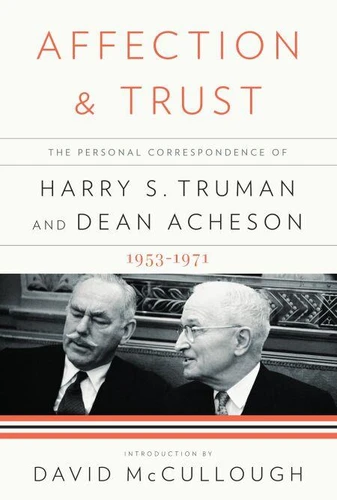
Affection and Trust. The Personal Correspondence of Harry S. Truman and Dean Acheson, 1953-1971
Par : , , , ,Formats :
Disponible dans votre compte client Decitre ou Furet du Nord dès validation de votre commande. Le format ePub protégé est :
- Compatible avec une lecture sur My Vivlio (smartphone, tablette, ordinateur)
- Compatible avec une lecture sur liseuses Vivlio
- Pour les liseuses autres que Vivlio, vous devez utiliser le logiciel Adobe Digital Edition. Non compatible avec la lecture sur les liseuses Kindle, Remarkable et Sony
- Non compatible avec un achat hors France métropolitaine
 , qui est-ce ?
Notre partenaire de plateforme de lecture numérique où vous retrouverez l'ensemble de vos ebooks gratuitement
Pour en savoir plus sur nos ebooks, consultez notre aide en ligne ici
C'est si simple ! Lisez votre ebook avec l'app Vivlio sur votre tablette, mobile ou ordinateur :

- Nombre de pages320
- FormatePub
- ISBN978-0-307-59462-4
- EAN9780307594624
- Date de parution02/11/2010
- Protection num.Adobe DRM
- Taille4 Mo
- Infos supplémentairesepub
- ÉditeurKnopf
Résumé
In this riveting collection, published for the first time, we follow Harry S. Truman and Dean Acheson, two giants of the post-World War II period, as they move from an official relationship to one of candor, humor, and personal expression. Together they were primarily responsible for the Marshall Plan and NATO, among other world-shaping initiatives. And in these letters, spanning the years from when both were newly out of office until Acheson's death at the age of seventy-eight, we find them sharing the often surprising and always illuminating opinions, ideas, and feelings that the strictures of their offices had previously kept them from revealing.
Adapting easily to their private lives, they nonetheless felt a powerful need to keep in touch as they viewed with dismay what they considered to be the Eisenhower administration's fumbling of foreign affairs, the impact of Joseph McCarthy, John Foster Dulles's foreign policy, and the threat of massive nuclear retaliation. Adlai Stevenson's poor campaign of 1956, Eisenhower's second-term mishaps, family events, speaking engagements, and Truman's difficulties writing his memoirs are all fodder for their conversations.
In 1960 their skeptical stance toward John F. Kennedy (and his father's influence) turned them toward Lyndon Johnson. After Kennedy won they discussed Acheson's reluctant involvement in the Cuban missile crisis, his missions to de Gaulle and Prime Minister Macmillan, and the Allied position in Berlin. Unbuttoned, careless of language, unburdened by political ambition or vanity, Truman and Acheson show their own characters and loyalty to each other on every page.
Truman, a Missouri farmer with the unpolished but sharp intellect of the largely self-educated man, clearly understands that in Acheson he has a friend with a rare gift for providing unhesitant and truthful counsel. Acheson, well-educated, urbane, and well-off, understands which traits in Truman's complex character to love and admire and when to admonish, instruct, and tease him. Both men share a deep and abiding patriotism, a quality that truly stands out in today's world.
A remarkable book that brings to light the very human side of two of the most important statesmen of the twentieth century.
Adapting easily to their private lives, they nonetheless felt a powerful need to keep in touch as they viewed with dismay what they considered to be the Eisenhower administration's fumbling of foreign affairs, the impact of Joseph McCarthy, John Foster Dulles's foreign policy, and the threat of massive nuclear retaliation. Adlai Stevenson's poor campaign of 1956, Eisenhower's second-term mishaps, family events, speaking engagements, and Truman's difficulties writing his memoirs are all fodder for their conversations.
In 1960 their skeptical stance toward John F. Kennedy (and his father's influence) turned them toward Lyndon Johnson. After Kennedy won they discussed Acheson's reluctant involvement in the Cuban missile crisis, his missions to de Gaulle and Prime Minister Macmillan, and the Allied position in Berlin. Unbuttoned, careless of language, unburdened by political ambition or vanity, Truman and Acheson show their own characters and loyalty to each other on every page.
Truman, a Missouri farmer with the unpolished but sharp intellect of the largely self-educated man, clearly understands that in Acheson he has a friend with a rare gift for providing unhesitant and truthful counsel. Acheson, well-educated, urbane, and well-off, understands which traits in Truman's complex character to love and admire and when to admonish, instruct, and tease him. Both men share a deep and abiding patriotism, a quality that truly stands out in today's world.
A remarkable book that brings to light the very human side of two of the most important statesmen of the twentieth century.