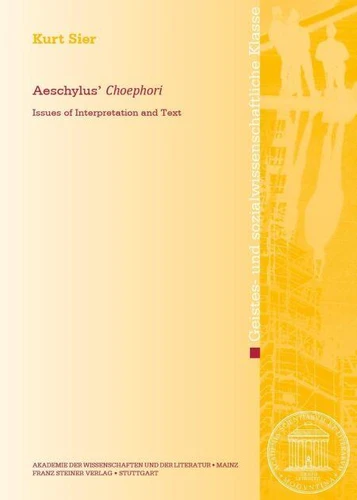
Aeschylus' "Choephori". Issues of Interpretation and Text
Par :Formats :
Disponible dans votre compte client Decitre ou Furet du Nord dès validation de votre commande. Le format PDF est :
- Compatible avec une lecture sur My Vivlio (smartphone, tablette, ordinateur)
- Compatible avec une lecture sur liseuses Vivlio
- Pour les liseuses autres que Vivlio, vous devez utiliser le logiciel Adobe Digital Edition. Non compatible avec la lecture sur les liseuses Kindle, Remarkable et Sony
 , qui est-ce ?
Notre partenaire de plateforme de lecture numérique où vous retrouverez l'ensemble de vos ebooks gratuitement
Pour en savoir plus sur nos ebooks, consultez notre aide en ligne ici
C'est si simple ! Lisez votre ebook avec l'app Vivlio sur votre tablette, mobile ou ordinateur :

- Nombre de pages68
- FormatPDF
- ISBN978-3-515-13826-0
- EAN9783515138260
- Date de parution28/11/2024
- Protection num.Digital Watermarking
- Taille789 Ko
- Infos supplémentairespdf
- ÉditeurFranz Steiner
Résumé
Choephori (or Libation Bearers) is the second play of Aeschylus' Oresteia. It was the main reference point for the Electras of Sophocles and Euripides and may be called the archetype of all later dramatizations of Orestes' matricide. But while Choephori can be considered the most influential part of the tragic trilogy in terms of theater history, it is also, paradoxically, the worst preserved of the three plays, its text resting upon a single medieval manuscript and being corrupt in many places.
This is one of the reasons why the drama continues to be controversial to an extent that even by , Aeschylean' standards seems exceptional. Although there is a vast amount of literature devoted to the Oresteia and there are excellent contributions dealing with its middle play, very many of the problems occurring in Choephori are still unsettled. The present study does not focus on general themes (e.g.
justice, gender, intertextuality), albeit such topics will necessarily arise in the course of the argument, nor does it claim to give a new overall interpretation. Rather, it intends to discuss questions concerning structure and performance and to address a number of issues that seem important for understanding the play.
This is one of the reasons why the drama continues to be controversial to an extent that even by , Aeschylean' standards seems exceptional. Although there is a vast amount of literature devoted to the Oresteia and there are excellent contributions dealing with its middle play, very many of the problems occurring in Choephori are still unsettled. The present study does not focus on general themes (e.g.
justice, gender, intertextuality), albeit such topics will necessarily arise in the course of the argument, nor does it claim to give a new overall interpretation. Rather, it intends to discuss questions concerning structure and performance and to address a number of issues that seem important for understanding the play.