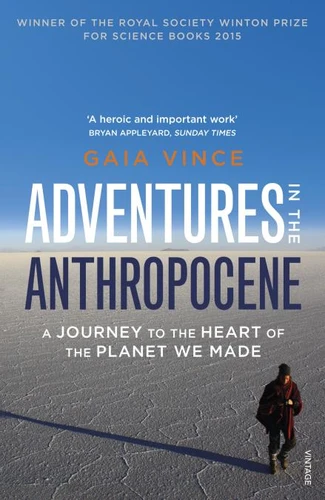
** Winner of Royal Society Winton Prize for Science Books 2015 **We live in epoch-making times. The changes we humans have made in recent decades have altered our world beyond anything it has experienced in its 4.6 billion-year history. As a result, our planet is said to be crossing into the Anthropocene - the Age of Humans. Gaia Vince decided to travel the world at the start of this new age to see what life is really like for the people on the frontline of the planet we've made.
From artificial glaciers in the Himalayas to painted mountains in Peru, electrified reefs in the Maldives to garbage islands in the Caribbean, Gaia found people doing the most extraordinary things to solve the problems that we ourselves have created. These stories show what the Anthropocene means for all of us - and they illuminate how we might engineer Earth for our future.
** Winner of Royal Society Winton Prize for Science Books 2015 **We live in epoch-making times. The changes we humans have made in recent decades have altered our world beyond anything it has experienced in its 4.6 billion-year history. As a result, our planet is said to be crossing into the Anthropocene - the Age of Humans. Gaia Vince decided to travel the world at the start of this new age to see what life is really like for the people on the frontline of the planet we've made.
From artificial glaciers in the Himalayas to painted mountains in Peru, electrified reefs in the Maldives to garbage islands in the Caribbean, Gaia found people doing the most extraordinary things to solve the problems that we ourselves have created. These stories show what the Anthropocene means for all of us - and they illuminate how we might engineer Earth for our future.