SOLDES
Jusqu'à -70% sur une sélection d'articles*

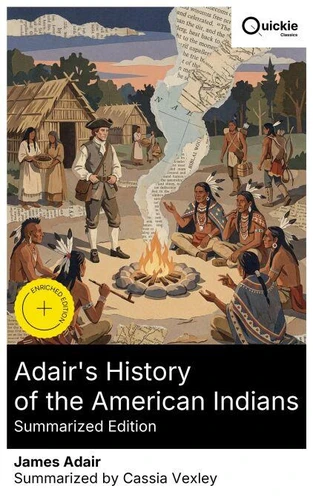
Adair's History of the American Indians (Summarized Edition). Enriched edition. A British Trader's Ethnography of Southeastern Tribes: Firsthand Narratives of Indigenous Societies and Social Traditions
Par : , , ,Formats :
Disponible dans votre compte client Decitre ou Furet du Nord dès validation de votre commande. Le format ePub est :
- Compatible avec une lecture sur My Vivlio (smartphone, tablette, ordinateur)
- Compatible avec une lecture sur liseuses Vivlio
- Pour les liseuses autres que Vivlio, vous devez utiliser le logiciel Adobe Digital Edition. Non compatible avec la lecture sur les liseuses Kindle, Remarkable et Sony
 , qui est-ce ?
Notre partenaire de plateforme de lecture numérique où vous retrouverez l'ensemble de vos ebooks gratuitement
Pour en savoir plus sur nos ebooks, consultez notre aide en ligne ici
C'est si simple ! Lisez votre ebook avec l'app Vivlio sur votre tablette, mobile ou ordinateur :

- Nombre de pages173
- FormatePub
- ISBN859-65--4789271-7
- EAN8596547892717
- Date de parution03/04/2026
- Protection num.Digital Watermarking
- Taille969 Ko
- Infos supplémentairesepub
- ÉditeurQUICKIE CLASSICS
Résumé
First published in 1775, Adair's History of the American Indians offers one of the earliest extended ethnographies of the southeastern tribes-Chickasaw, Cherokee, Choctaw, Creek, Catawba-drawn from four decades of trade and travel. Part travel narrative, part polemic, the book catalogs kinship systems, councils, warfare, ritual purification, gendered labor, and deerskin commerce with a concreteness unusual for its day.
Its argumentative spine-the notorious claim that American Indians descended from the Ten Lost Tribes of Israel-anchors a sprawling apparatus of linguistic parallels and Mosaic analogies, revealing Enlightenment-era obsessions with origins even as Adair records granular social practice. James Adair, a Scots-Irish trader who emigrated to the southern colonies in the 1730s and lived chiefly among the Chickasaw, gained intimate access as a negotiator and purveyor of goods.
His Presbyterian background and immersion in biblical typology shaped his comparative method; his experiences in the deerskin economy and imperial borderlands sharpened his critiques of colonial corruption and French-Spanish intrigue. Read today, Adair's volume is indispensable as a primary source yet demands a critical, decolonizing lens. Scholars of ethnohistory, anthropology, religious studies, and colonial America will find both rich description and revealing bias; general readers will encounter a vivid, argumentative voice from the eighteenth-century frontier. Quickie Classics summarizes timeless works with precision, preserving the author's voice and keeping the prose clear, fast, and readable-distilled, never diluted.
Enriched Edition extras: Introduction · Synopsis · Historical Context · Brief Analysis · 4 Reflection Q&As · Editorial Footnotes.
Its argumentative spine-the notorious claim that American Indians descended from the Ten Lost Tribes of Israel-anchors a sprawling apparatus of linguistic parallels and Mosaic analogies, revealing Enlightenment-era obsessions with origins even as Adair records granular social practice. James Adair, a Scots-Irish trader who emigrated to the southern colonies in the 1730s and lived chiefly among the Chickasaw, gained intimate access as a negotiator and purveyor of goods.
His Presbyterian background and immersion in biblical typology shaped his comparative method; his experiences in the deerskin economy and imperial borderlands sharpened his critiques of colonial corruption and French-Spanish intrigue. Read today, Adair's volume is indispensable as a primary source yet demands a critical, decolonizing lens. Scholars of ethnohistory, anthropology, religious studies, and colonial America will find both rich description and revealing bias; general readers will encounter a vivid, argumentative voice from the eighteenth-century frontier. Quickie Classics summarizes timeless works with precision, preserving the author's voice and keeping the prose clear, fast, and readable-distilled, never diluted.
Enriched Edition extras: Introduction · Synopsis · Historical Context · Brief Analysis · 4 Reflection Q&As · Editorial Footnotes.