SOLDES
Jusqu'à -70% sur une sélection d'articles*

Nouveauté
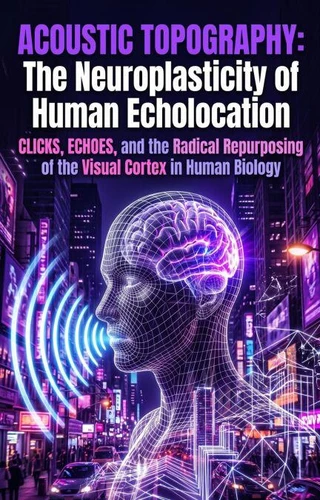
Acoustic Topography: The Neuroplasticity of Human Echolocation. Clicks, Echoes, and the Radical Repurposing of the Visual Cortex in Human Biology
Par :Formats :
Disponible dans votre compte client Decitre ou Furet du Nord dès validation de votre commande. Le format ePub est :
- Compatible avec une lecture sur My Vivlio (smartphone, tablette, ordinateur)
- Compatible avec une lecture sur liseuses Vivlio
- Pour les liseuses autres que Vivlio, vous devez utiliser le logiciel Adobe Digital Edition. Non compatible avec la lecture sur les liseuses Kindle, Remarkable et Sony
 , qui est-ce ?
Notre partenaire de plateforme de lecture numérique où vous retrouverez l'ensemble de vos ebooks gratuitement
Pour en savoir plus sur nos ebooks, consultez notre aide en ligne ici
C'est si simple ! Lisez votre ebook avec l'app Vivlio sur votre tablette, mobile ou ordinateur :

- Nombre de pages164
- FormatePub
- ISBN978-3-565-49684-6
- EAN9783565496846
- Date de parution14/06/2026
- Protection num.pas de protection
- Taille875 Ko
- Infos supplémentairesepub
- ÉditeurEmphaloz Publishing House
Résumé
How is it physically possible for a completely blind individual to confidently ride a bicycle through a crowded, unfamiliar city street without a cane? The answer lies in one of the most staggering demonstrations of human biological adaptability ever recorded by modern science: human echolocation.
By producing sharp, precise tongue clicks, certain blind individuals have trained themselves to analyze the returning acoustic echoes to determine the exact size, distance, and density of surrounding physical objects.
When neuroscientists placed these expert echolocators inside functional MRI machines, the results were paradigm-shattering. The returning auditory echoes were not simply being processed by the brain's auditory centers; they were actively illuminating the visual cortex. The brain had literally rewired its own hardware, translating raw acoustic data into highly accurate spatial geometry. This profound medical analysis explores the absolute limits of sensory substitution.
It unpacks the acoustic physics of the tongue click, the grueling cognitive training required to master environmental mapping, and the radical implications for rehabilitative neurology. Redefine your understanding of the human senses. Exploring human echolocation proves that our brains are not rigidly wired machines, but fluid, desperately adaptive engines capable of seeing the world entirely through sound.
When neuroscientists placed these expert echolocators inside functional MRI machines, the results were paradigm-shattering. The returning auditory echoes were not simply being processed by the brain's auditory centers; they were actively illuminating the visual cortex. The brain had literally rewired its own hardware, translating raw acoustic data into highly accurate spatial geometry. This profound medical analysis explores the absolute limits of sensory substitution.
It unpacks the acoustic physics of the tongue click, the grueling cognitive training required to master environmental mapping, and the radical implications for rehabilitative neurology. Redefine your understanding of the human senses. Exploring human echolocation proves that our brains are not rigidly wired machines, but fluid, desperately adaptive engines capable of seeing the world entirely through sound.