
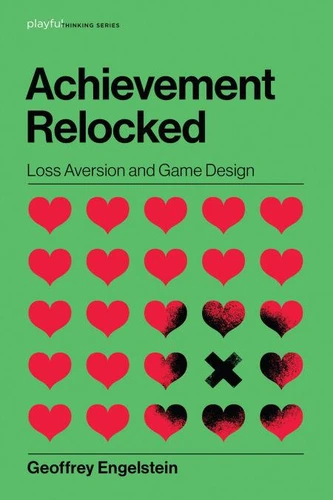
Achievement Relocked. Loss Aversion and Game Design
Par :Formats :
Disponible dans votre compte client Decitre ou Furet du Nord dès validation de votre commande. Le format ePub protégé est :
- Compatible avec une lecture sur My Vivlio (smartphone, tablette, ordinateur)
- Compatible avec une lecture sur liseuses Vivlio
- Pour les liseuses autres que Vivlio, vous devez utiliser le logiciel Adobe Digital Edition. Non compatible avec la lecture sur les liseuses Kindle, Remarkable et Sony
- Non compatible avec un achat hors France métropolitaine
 , qui est-ce ?
Notre partenaire de plateforme de lecture numérique où vous retrouverez l'ensemble de vos ebooks gratuitement
Pour en savoir plus sur nos ebooks, consultez notre aide en ligne ici
C'est si simple ! Lisez votre ebook avec l'app Vivlio sur votre tablette, mobile ou ordinateur :

- Nombre de pages152
- FormatePub
- ISBN978-0-262-35705-0
- EAN9780262357050
- Date de parution18/02/2020
- Protection num.Adobe DRM
- Taille6 Mo
- Infos supplémentairesepub
- ÉditeurThe MIT Press
Résumé
How game designers can use the psychological phenomenon of loss aversion to shape player experience. Getting something makes you feel good, and losing something makes you feel bad. But losing something makes you feel worse than getting the same thing makes you feel good. So finding $10 is a thrill; losing $10 is a tragedy. On an "intensity of feeling" scale, loss is more intense than gain. This is the core psychological concept of loss aversion, and in this book game creator Geoffrey Engelstein explains, with examples from both tabletop and video games, how it can be a tool in game design.
Loss aversion is a profound aspect of human psychology, and directly relevant to game design; it is a tool the game designer can use to elicit particular emotions in players. Engelstein connects the psychology of loss aversion to a range of phenomena related to games, exploring, for example, the endowment effect-why, when an object is ours, it gains value over an equivalent object that is not ours-as seen in the Weighted Companion Cube in the game Portal; the framing of gains and losses to manipulate player emotions; Deal or No Deal's use of the utility theory; and regret and competence as motivations, seen in the context of legacy games.
Finally, Engelstein examines the approach to loss aversion in three games by Uwe Rosenberg, charting the designer's increasing mastery.
Loss aversion is a profound aspect of human psychology, and directly relevant to game design; it is a tool the game designer can use to elicit particular emotions in players. Engelstein connects the psychology of loss aversion to a range of phenomena related to games, exploring, for example, the endowment effect-why, when an object is ours, it gains value over an equivalent object that is not ours-as seen in the Weighted Companion Cube in the game Portal; the framing of gains and losses to manipulate player emotions; Deal or No Deal's use of the utility theory; and regret and competence as motivations, seen in the context of legacy games.
Finally, Engelstein examines the approach to loss aversion in three games by Uwe Rosenberg, charting the designer's increasing mastery.