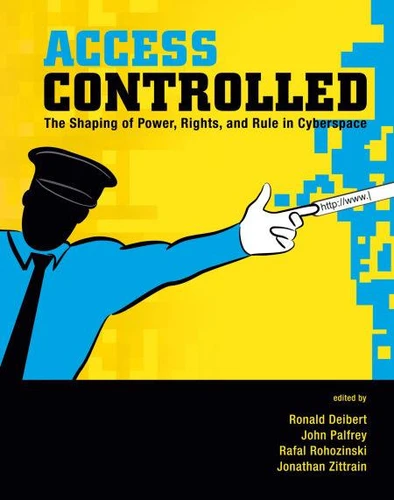
Reports on a new generation of Internet controls that establish a new normative terrain in which surveillance and censorship are routine. Internet filtering, censorship of Web content, and online surveillance are increasing in scale, scope, and sophistication around the world, in democratic countries as well as in authoritarian states. The first generation of Internet controls consisted largely of building firewalls at key Internet gateways; China's famous "Great Firewall of China" is one of the first national Internet filtering systems.
Today the new tools for Internet controls that are emerging go beyond mere denial of information. These new techniques, which aim to normalize (or even legalize) Internet control, include targeted viruses and the strategically timed deployment of distributed denial-of-service (DDoS) attacks, surveillance at key points of the Internet's infrastructure, take-down notices, stringent terms of usage policies, and national information shaping strategies.
Access Controlled reports on this new normative terrain. The book, a project from the OpenNet Initiative (ONI), a collaboration of the Citizen Lab at the University of Toronto's Munk Centre for International Studies, Harvard's Berkman Center for Internet and Society, and the SecDev Group, offers six substantial chapters that analyze Internet control in both Western and Eastern Europe and a section of shorter regional reports and country profiles drawn from material gathered by the ONI around the world through a combination of technical interrogation and field research methods.
Reports on a new generation of Internet controls that establish a new normative terrain in which surveillance and censorship are routine. Internet filtering, censorship of Web content, and online surveillance are increasing in scale, scope, and sophistication around the world, in democratic countries as well as in authoritarian states. The first generation of Internet controls consisted largely of building firewalls at key Internet gateways; China's famous "Great Firewall of China" is one of the first national Internet filtering systems.
Today the new tools for Internet controls that are emerging go beyond mere denial of information. These new techniques, which aim to normalize (or even legalize) Internet control, include targeted viruses and the strategically timed deployment of distributed denial-of-service (DDoS) attacks, surveillance at key points of the Internet's infrastructure, take-down notices, stringent terms of usage policies, and national information shaping strategies.
Access Controlled reports on this new normative terrain. The book, a project from the OpenNet Initiative (ONI), a collaboration of the Citizen Lab at the University of Toronto's Munk Centre for International Studies, Harvard's Berkman Center for Internet and Society, and the SecDev Group, offers six substantial chapters that analyze Internet control in both Western and Eastern Europe and a section of shorter regional reports and country profiles drawn from material gathered by the ONI around the world through a combination of technical interrogation and field research methods.


 , qui est-ce ?