LONG ANSWER: Anything, that can happen, will happen, regardless of how improbable it might be, given sufficient time. SHORT ANSWER: Yes. QUESTION: Are we going to have a nuclear war?NEXT QUESTION: Will anyone survive?ANSWER: Maybe.- What if they're off-planet when it happens?- They'll all die, except for the few ifny who adapt, but fast!- Will cælestials and terrestrials eventually reunite?- There's a problem with that: When a group is cut in 2, and the pieces are kept apart for long enough, in reunion each will discover th'other to be a separate strain.
That's how it starts - the Strains series, hard science fiction for a specific vanishingly·small target audience = literate ? numerate ? imaginative. Strain 1: A strain is a sub·species. StarShip Prosperity is returning Terran humanity to outer space for the first time since Collapse 3 centuries ago. The crew of 4, all military, hopes to re·establish contact with the descendants of those who were stranded up there, yet some·how survived all this time.
This is an experimental hybrid sci·fi novel, the 1st in a series of 5. After such a long separation, the characters have so much to discuss that, for simplicity, the text is largely formatted like a play. Don't worry, it's not all talk, yet th'action is often so strange that it makes more sense to let the characters themselves describe it. The texts and backgrounds come in different colors, partly in lieu of punctuation, so it's largely unintelligible in black·and·white.
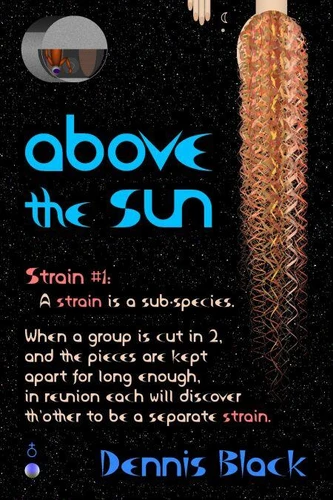
Th'action obeys the laws of Kepler and Newton - other laws, not so much. The languages are not quite what we're used to, nor should they be, so many centuries on. The cultural differences are naturally - as·well·as un·naturally - out of this world. The title alludes to th'Old Testament dictum, There is no new thing under the sun. Not your normal CGI, the cover comes from a throw·away stand·alone C program relying on no·thing more exotic than stone·age UNIX math and i/o - a few hundred lines, half of it just for defining the 1·off font.
If you look at the hair from different distances, you get totally different effects. Beauty is in the eye of the beholder, especially if the beholder doesn't get too close. A quixotic frontal assault upon grammar, orthology and standard manuscript format, targeting a vanishingly small audience of those both literate and numerate. REQUIRES COLOR. sf ? f = Ø
LONG ANSWER: Anything, that can happen, will happen, regardless of how improbable it might be, given sufficient time. SHORT ANSWER: Yes. QUESTION: Are we going to have a nuclear war?NEXT QUESTION: Will anyone survive?ANSWER: Maybe.- What if they're off-planet when it happens?- They'll all die, except for the few ifny who adapt, but fast!- Will cælestials and terrestrials eventually reunite?- There's a problem with that: When a group is cut in 2, and the pieces are kept apart for long enough, in reunion each will discover th'other to be a separate strain.
That's how it starts - the Strains series, hard science fiction for a specific vanishingly·small target audience = literate ? numerate ? imaginative. Strain 1: A strain is a sub·species. StarShip Prosperity is returning Terran humanity to outer space for the first time since Collapse 3 centuries ago. The crew of 4, all military, hopes to re·establish contact with the descendants of those who were stranded up there, yet some·how survived all this time.
This is an experimental hybrid sci·fi novel, the 1st in a series of 5. After such a long separation, the characters have so much to discuss that, for simplicity, the text is largely formatted like a play. Don't worry, it's not all talk, yet th'action is often so strange that it makes more sense to let the characters themselves describe it. The texts and backgrounds come in different colors, partly in lieu of punctuation, so it's largely unintelligible in black·and·white.
Th'action obeys the laws of Kepler and Newton - other laws, not so much. The languages are not quite what we're used to, nor should they be, so many centuries on. The cultural differences are naturally - as·well·as un·naturally - out of this world. The title alludes to th'Old Testament dictum, There is no new thing under the sun. Not your normal CGI, the cover comes from a throw·away stand·alone C program relying on no·thing more exotic than stone·age UNIX math and i/o - a few hundred lines, half of it just for defining the 1·off font.
If you look at the hair from different distances, you get totally different effects. Beauty is in the eye of the beholder, especially if the beholder doesn't get too close. A quixotic frontal assault upon grammar, orthology and standard manuscript format, targeting a vanishingly small audience of those both literate and numerate. REQUIRES COLOR. sf ? f = Ø

 , qui est-ce ?



