
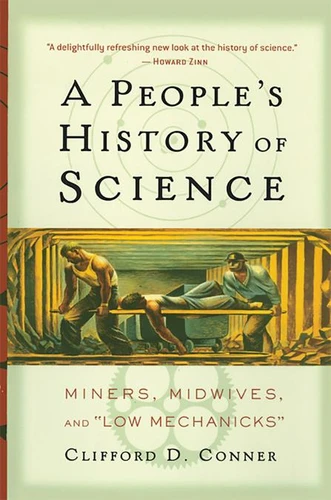
A People's History of Science. Miners, Midwives, and Low Mechanicks
Par :Formats :
Disponible dans votre compte client Decitre ou Furet du Nord dès validation de votre commande. Le format ePub protégé est :
- Compatible avec une lecture sur My Vivlio (smartphone, tablette, ordinateur)
- Compatible avec une lecture sur liseuses Vivlio
- Pour les liseuses autres que Vivlio, vous devez utiliser le logiciel Adobe Digital Edition. Non compatible avec la lecture sur les liseuses Kindle, Remarkable et Sony
- Non compatible avec un achat hors France métropolitaine
 , qui est-ce ?
Notre partenaire de plateforme de lecture numérique où vous retrouverez l'ensemble de vos ebooks gratuitement
Pour en savoir plus sur nos ebooks, consultez notre aide en ligne ici
C'est si simple ! Lisez votre ebook avec l'app Vivlio sur votre tablette, mobile ou ordinateur :

- Nombre de pages424
- FormatePub
- ISBN978-0-7867-3786-4
- EAN9780786737864
- Date de parution23/04/2009
- Protection num.Adobe DRM
- Infos supplémentairesepub
- ÉditeurBold Type Books
Résumé
We all know the history of science that we learned from grade school textbooks: How Galileo used his telescope to show that the earth was not the center of the universe; how Newton divined gravity from the falling apple; how Einstein unlocked the mysteries of time and space with a simple equation. This history is made up of long periods of ignorance and confusion, punctuated once an age by a brilliant thinker who puts it all together.
These few tower over the ordinary mass of people, and in the traditional account, it is to them that we owe science in its entirety. This belief is wrong. A People's History of Science shows how ordinary people participate in creating science and have done so throughout history. It documents how the development of science has affected ordinary people, and how ordinary people perceived that development.
It would be wrong to claim that the formulation of quantum theory or the structure of DNA can be credited directly to artisans or peasants, but if modern science is likened to a skyscraper, then those twentieth-century triumphs are the sophisticated filigrees at its pinnacle that are supported by the massive foundation created by the rest of us.
These few tower over the ordinary mass of people, and in the traditional account, it is to them that we owe science in its entirety. This belief is wrong. A People's History of Science shows how ordinary people participate in creating science and have done so throughout history. It documents how the development of science has affected ordinary people, and how ordinary people perceived that development.
It would be wrong to claim that the formulation of quantum theory or the structure of DNA can be credited directly to artisans or peasants, but if modern science is likened to a skyscraper, then those twentieth-century triumphs are the sophisticated filigrees at its pinnacle that are supported by the massive foundation created by the rest of us.