John Milloy is professor in the departments of Native Studies and History, and Master of Peter Robinson College, Trent University, Peterborough, Ontario.
Mary Jane Logan McCallum is a Professor in the Department of History at University of Winnipeg.
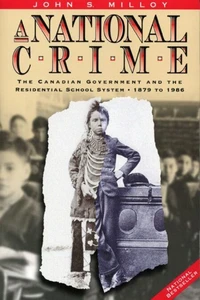
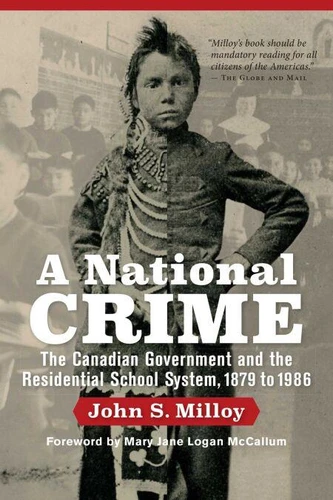
A National Crime. The Canadian Government and the Residential School System
Par : ,Formats :
Disponible dans votre compte client Decitre ou Furet du Nord dès validation de votre commande. Le format ePub est :
- Compatible avec une lecture sur My Vivlio (smartphone, tablette, ordinateur)
- Compatible avec une lecture sur liseuses Vivlio
- Pour les liseuses autres que Vivlio, vous devez utiliser le logiciel Adobe Digital Edition. Non compatible avec la lecture sur les liseuses Kindle, Remarkable et Sony
 , qui est-ce ?
Notre partenaire de plateforme de lecture numérique où vous retrouverez l'ensemble de vos ebooks gratuitement
Pour en savoir plus sur nos ebooks, consultez notre aide en ligne ici
C'est si simple ! Lisez votre ebook avec l'app Vivlio sur votre tablette, mobile ou ordinateur :

- Nombre de pages465
- FormatePub
- ISBN978-0-88755-519-0
- EAN9780887555190
- Date de parution29/03/2017
- Protection num.Digital Watermarking
- Taille2 Mo
- Infos supplémentairesepub
- ÉditeurUniversity of Manitoba Press
Résumé
WINNER Literary Review of Canada's 100 Most Important Canadian Books, 2005
WINNER Margaret McWilliams Award, 1999
"I am going to tell you how we are treated. I am always hungry."-Edward B., a student at Onion Lake School (1923)
"[I]f I were appointed by the Dominion Government for the express purpose of spreading tuberculosis, there is nothing finer in existance that the average Indian residential school."-N.
Walker, Indian Affairs Superintendent (1948) For over 100 years, thousands of Aboriginal children passed through the Canadian residential school system. Begun in the 1870s, it was intended, in the words of government officials, to bring these children into the "circle of civilization"; the results, however, were far different. More often, the schools provided an inferior education in an atmosphere of neglect, disease, and often abuse. Using previously unreleased government documents, historian John S.
Milloy provides a full picture of the history and reality of the residential school system. He begins by tracing the ideological roots of the system, and follows the paper trail of internal memoranda, reports from field inspectors, and letters of complaint. In the early decades, the system grew without planning or restraint. Despite numerous critical commissions and reports, it persisted into the 1970s, when it transformed itself into a social welfare system without improving conditions for its thousands of wards. A National Crime shows that the residential system was chronically underfunded and often mismanaged, and documents in detail how this affected the health, education, and well-being of entire generations of Indigenous children.
Walker, Indian Affairs Superintendent (1948) For over 100 years, thousands of Aboriginal children passed through the Canadian residential school system. Begun in the 1870s, it was intended, in the words of government officials, to bring these children into the "circle of civilization"; the results, however, were far different. More often, the schools provided an inferior education in an atmosphere of neglect, disease, and often abuse. Using previously unreleased government documents, historian John S.
Milloy provides a full picture of the history and reality of the residential school system. He begins by tracing the ideological roots of the system, and follows the paper trail of internal memoranda, reports from field inspectors, and letters of complaint. In the early decades, the system grew without planning or restraint. Despite numerous critical commissions and reports, it persisted into the 1970s, when it transformed itself into a social welfare system without improving conditions for its thousands of wards. A National Crime shows that the residential system was chronically underfunded and often mismanaged, and documents in detail how this affected the health, education, and well-being of entire generations of Indigenous children.